Theater History & Optics
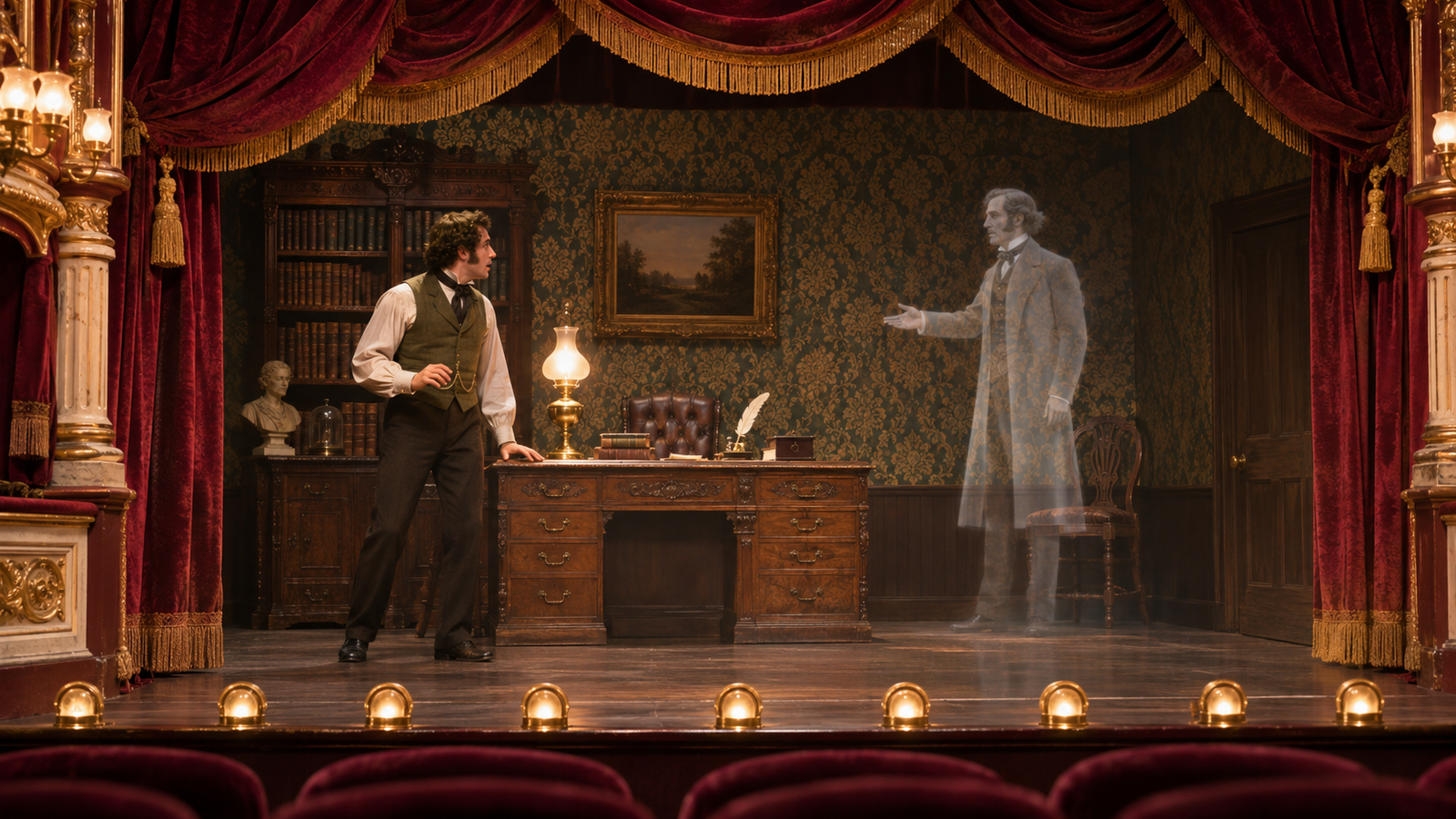
The ghost on the Victorian stage was a reflection of a performer the audience couldn’t see directly.
A large pane of angled glass let spectators see the set while reflecting light from a hidden performer into their eyes. When the crew lit that performer, an apparition seemed to take shape beside the actors. Dim the hidden light, and the figure faded while the room around it remained visible. The glass could stay in the same position throughout the scene.
How the illusion reached a London audience
In late 1862, audiences at London’s Royal Polytechnic Institution saw an optical illusion associated with a presentation of Charles Dickens’s The Haunted Man. A ghost story gave the demonstration an immediate dramatic purpose. A figure could appear where a moment before there had been an ordinary stage. Whatever the audience expected from an illustrated reading, the appearance of a life-sized apparition made light itself part of the performance.
The effect took its familiar name from John Henry Pepper, a science lecturer and showman associated with the Polytechnic. It also owed a great deal to Henry Dircks, who had developed an earlier scheme for making a stage figure appear by reflection. Pepper adapted the idea for presentation, arranging the hidden performance area and glass so the effect could work in a theater setting. The name remembers the man who helped make the illusion famous. Its development belongs to both men.
The Polytechnic was a fitting place to see it. A visitor could come for an entertaining evening and encounter a demonstration of how light behaves. Pepper’s Ghost put that relationship to work in reverse, too. The scientific principle gave the show a convincing apparition, and the drama gave people a reason to care about a pane of glass they could scarcely see.
Reflection had long been familiar from mirrors and windows. Making it work across a stage presented a larger problem. The image had to appear at a useful height and in a plausible part of the set. The audience had to miss the equipment while looking straight toward it. And the ghost had to make its entrance on cue, night after night. The practical achievement was turning a simple optical effect into something actors and stage crews could rehearse.
Two views reach the audience through one pane
Think of a shop window after dark. You can see the display through the glass and, if the street is bright enough, a reflection laid over it. Someone walking past outside may briefly seem to cross the interior of the shop. Pepper’s Ghost uses the same combination of transmitted and reflected light, with the positions and lighting chosen in advance.
On stage, light from the visible set passes through the pane toward the audience. Light from a hidden performer strikes the glass from another direction. Some of it reflects toward those same spectators. From their seats, both views arrive together. They see the set directly and the performer as an image that appears to occupy part of it.
The diagram shows the idea from above. Victorian arrangements could conceal the performer below the visible stage, in which case the important geometry is easier to picture from the side. In either view, the glass turns light from a concealed area toward the seats.
Why the ghost seems to stand behind the glass
When you look in a bathroom mirror, your reflection appears to occupy space behind its surface. You can lean toward the mirror and the image seems to approach from the other side. The light reaching your eyes has bounced off the mirror, but your view follows the direction it arrives from. In optics, that apparent figure is called a virtual image.
The stage glass does the same thing while still letting the audience see through it. The apparition can therefore look as if it stands beside a chair, between two actors, or just past a doorway. Its apparent location depends on where the hidden performer stands in relation to the pane. If the performer steps to a new spot, the image moves as well. Within the usable viewing area, an actor can rehearse with that apparent position in mind.
The ghost’s transparency comes from seeing the scenery and the reflection along the same line of sight. Suppose the ghost appears in front of a patterned wall. The wall remains visible through the paler parts of the image because light from the pattern continues to reach the audience. Light-colored costume details can catch enough light to show up clearly. A dark sleeve against a dark background in the hidden area may reveal very little.
The entrance was a lighting cue
Picture a scene in which a character sits alone at a table. A second performer waits in a concealed area. A chair on the visible set gives the audience a clear idea of where the apparition is about to appear. The stage crew can make the visitor seem to arrive without opening a door or moving anything on the visible set.
-
Establish the room
Keep enough light on the table, chair, and visible actor for spectators to read the scene. With the concealed area dark, very little light from it reaches the audience through reflection.
-
Reveal the figure
Raise the light on the hidden performer. A face or pale costume starts to register as a reflection. A gradual rise gives the audience time to watch the figure take shape.
-
Let the figure fade
Lower the hidden light while maintaining the visible scene. The seated character can keep looking toward the spot for a moment, giving the disappearance a clear dramatic ending.
The balance between the two light levels determines how this looks. A bright set can overwhelm a faint reflection. A bright hidden area can reveal a backdrop, floor, or object that also catches the light. Lighting the performer selectively lets the crew reveal a face, hand, or costume without bringing the entire concealed space into view.
Timing also changes the meaning of the entrance. If the ghost appears before the seated character notices it, the audience knows something the character doesn’t. If both seem to discover it at once, the scene plays as a shared shock. An actor who turns a little too early can draw everyone’s eyes to an empty chair. An actor who turns too late may leave spectators wondering whether the character can see the visitor at all.
What made the effect convincing from the seats
A spectator has to see the reflected image through the usable area of glass. From a central seat, the ghost may be visible from head to foot, with its feet apparently resting near a stage mark. A spectator far to one side might see part of the figure disappear where its reflection runs beyond the pane’s edge. A large sheet gives the designer more room to work, but the width of the audience and the geometry still matter.
The pane also needs to stay inconspicuous. Light aimed carelessly at the set can produce an unwanted reflection. A visible edge can reveal where the transparent surface begins. Scenic details and dark openings give the crew places to conceal the pane’s boundaries. A convincing setup is judged from the seats, where the audience sees the combined image, rather than solely from backstage, where the separate pieces are easy to inspect.
The performers have a different problem. The actor on the visible stage may see the ghost poorly from their position, so the scene can depend on rehearsal marks. Imagine asking an actor to raise a hand until it nearly touches the apparition. From a suitable seat, the two hands can seem within inches of one another. For the actor, that moment may mean holding a hand beside a particular chair back and waiting for a cue.
| What spectators see | What can produce it |
|---|---|
| The figure seems too faint. | The set is bright compared with the light reaching the hidden performer. |
| A rectangular patch appears behind the ghost. | A backdrop or surface in the concealed area is also reflecting into view. |
| Part of the figure disappears from a side seat. | That seat’s view of the reflection runs past the usable edge of the pane. |
| The actor seems to look beside the figure. | The actor’s eye line misses the apparent position of the image. |
Real objects can create another complication. If the reflected image appears to stand behind a piece of scenery but you can still see the ghost across the front of that object, the two views give the audience conflicting clues about depth. Designers can limit this by choosing a clear space for the apparition or blocking the action so the overlap looks intentional. A ghost that seems to pass through a chair might be effective in one scene and spoil a carefully staged handshake in another.
Why the effect still turns up in exhibitions and shows
The original staging used a hidden performer. Variations can use a physical object, a model, or an image from a concealed display. A museum can use the technique to make a figure appear beside an object in a case. A theatrical production can place a recorded character among live performers. The design still depends on sending a reflection toward viewers while giving them a direct view of the space where the image seems to appear.
The setting changes how much control a designer has. A display case can place the glass, object, and image source close together and discourage people from viewing it at an awkward angle. A theater has seats spread across a room, a larger image, and performers who need room to move. A version that looks excellent at the center of a small case can take much more work to scale up for a live show.
Modern advertising sometimes calls these effects holograms. In a Pepper’s Ghost setup, the visible figure is a reflection redirected by glass or a similar transparent surface. A recorded video can make that figure move and speak, but any details of the image are still coming from the concealed source. The descriptive clue is the sightline. If you watch from a place where the transparent surface can no longer redirect that source toward you, the illusion falls away.
You can see the basic principle without stage equipment. At dusk, stand indoors and look through a window with a lamp lit somewhere behind you. Find a spot where you can see both the outdoors and the lamp’s reflection. Turn the lamp off and look at the same part of the window. The outdoor view stays, while the reflected object disappears. The Victorian version put a performer in the lamp’s place and gave someone backstage control over the timing.
Questions about the Victorian illusion
Was the ghost projected onto the glass?
The classic arrangement reflected light from a real performer hidden from direct view. The glass redirected the light toward spectators. The apparition appeared beyond the pane, in the space of the visible stage. Modern versions can use a projected or displayed image as the concealed source and then reflect that image into the scene.
Did the glass have to sit at exactly 45 degrees?
A 45-degree pane is a convenient way to turn a light path through a right angle, as in the simplified diagram. Actual placement depends on where the concealed performer stands and where the audience sits. The glass has to reflect light from the source toward the intended viewing area and put the image at a useful position in the scene.
Could the ghost move around?
Yes. Moving in the hidden area moves the reflection the audience sees. The performer has to stay within the part of the hidden area that the pane can reflect toward the seats. A short, well-rehearsed movement can be enough to make the apparition seem to approach a character or lean across a table.
Why couldn’t the audience see the hidden performer directly?
Their sightline to the concealed area was blocked by the stage arrangement. The glass gave light from that area a separate route to the seats. For the illusion to work, the set had to conceal the source while leaving that reflected path open.