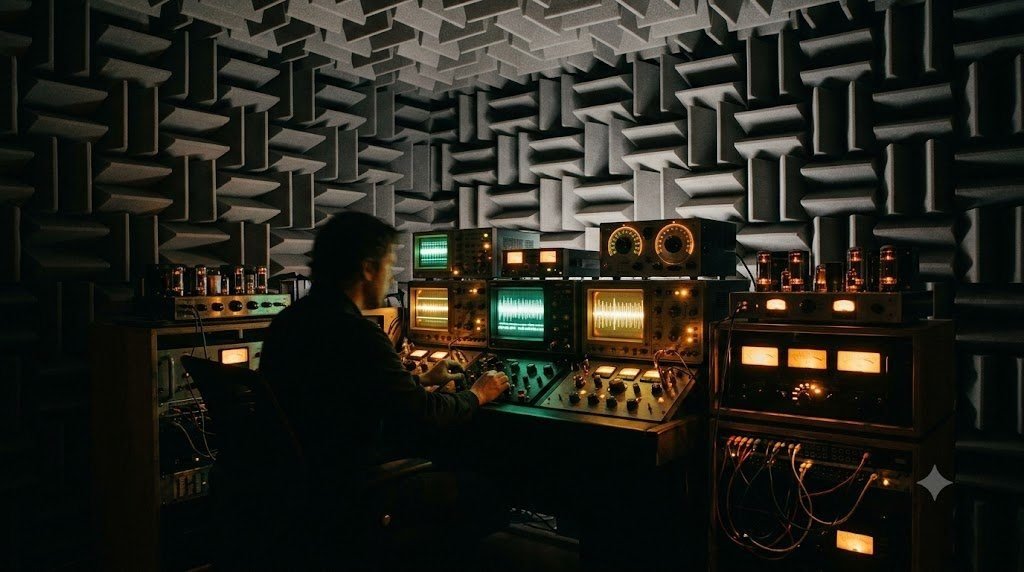
The Architecture of Hearing: Tonotopic Organization and Auditory Scene Analysis
While visual illusions dominate popular culture and scientific literature, the human auditory system is equally susceptible to profound perceptual deceptions, phantom sensations, and paradoxical loops. Sound is fundamentally a mechanical perturbation—a continuous wave of alternating atmospheric compression and rarefaction traveling through the air. From the moment these vibrations strike the tympanic membrane and are mechanically amplified by the ossicular chain of the middle ear (malleus, incus, and stapes), they enter the fluid-filled cochlea of the inner ear.
Inside the cochlea, sound waves traverse the basilar membrane, which is tonotopically organized like a microscopic biological harp: stiff and narrow at the base to resonate with high frequencies, and broad and flexible at the apex to resonate with low frequencies. Hair cells lining the organ of Corti transduce these physical resonances into electrical action potentials, firing along the vestibulocochlear nerve (Cranial Nerve VIII) through the cochlear nucleus, the superior olivary complex, the inferior colliculus, and the medial geniculate nucleus of the thalamus, finally arriving at the primary auditory cortex (A1) within the superior temporal gyrus.
However, hearing a complex acoustic environment—such as a crowded restaurant or an orchestral symphony—requires far more than registering frequencies. The brain must solve the immense computational challenge of ‘Auditory Scene Analysis’ (formulated by Albert Bregman): parsing overlapping waveforms, separating distinct voices, grouping harmonics, and filling in missing acoustic gaps. When specialized sound designs deliberately exploit the brain’s harmonic heuristics, the auditory cortex can be trapped inside acoustic infinite loops, ambiguous musical paradoxes, and phantom verbal hallucinations.
🎵 Key Psychoacoustic Concept: Pitch Height vs Pitch Chroma
Human pitch perception is organized along two distinct psychological dimensions: Pitch Height (the monotonic increase from low to high frequency across the audible spectrum) and Pitch Chroma (the cyclic identity of notes within an octave, where two notes an octave apart share the same harmonic chroma). Auditory paradoxes exploit this separation.
The Shepard Tone: The Sonic Barberpole of Infinite Ascent
In 1964, cognitive scientist Roger Shepard at Bell Laboratories unveiled what is universally recognized as the acoustic equivalent of M.C. Escher’s infinite staircase: the ‘Shepard Tone’ (or Shepard Scale). When an observer listens to a Shepard scale, they hear a sequence of tones that appears to continuously, endlessly ascend in pitch, rising higher and higher into infinity, without ever actually getting any higher in overall frequency.
The psychoacoustic engine behind the Shepard tone is the mathematical separation of pitch height from pitch chroma. A Shepard tone is not a pure single-frequency sinusoidal wave; rather, it is a complex polyphonic chord composed of multiple sine waves separated by exact octave intervals (such as 110 Hz, 220 Hz, 440 Hz, 880 Hz, 1760 Hz, and 3520 Hz). These simultaneous octaves are passed through a stationary bell-shaped spectral envelope (a Gaussian filter) that governs their relative amplitudes.
As the notes of the scale step upward in pitch chroma (e.g., C, C#, D, D#), the highest octave tones in the chord gradually diminish in loudness and fade to absolute silence as they reach the upper threshold of the Gaussian envelope. Simultaneously, new microscopic low-frequency tones enter at the bottom threshold of the envelope, rising in volume as they approach the center. Because the listener’s attention is captivated by the upward movement of the prominent middle frequencies, the brain fails to register the quiet death of high frequencies and the birth of low ones. The result is an endless auditory illusion of infinite ascension.
| Auditory Illusion | Discoverer / Pioneer | Acoustic / Harmonic Mechanism | Cortical / Cognitive Locus | Notable Cultural / Media Application |
|---|---|---|---|---|
| Shepard Tone Scale | Roger Shepard (1964) | Octave chords with stationary Gaussian amplitude envelope | Primary Auditory Cortex (A1) & Planum Temporale | Hans Zimmer’s Dunkirk score & Batman Batpod engine |
| The Tritone Paradox | Diana Deutsch (1986) | Bistable Shepard tones separated by half an octave | Pitch processing networks & linguistic exposure | Auditory equivalent of the Necker Cube; dialect-dependent |
| The Haas Precedence Effect | Helmut Haas (1949) | Primary sound arrival suppresses spatial echo reflections | Inferior Colliculus & Auditory Brainstem | Architectural acoustic design & live concert line arrays |
| The Franssen Effect | N.V. Franssen (1962) | Transient onset localization overrides steady-state tone | Binaural localization circuits (MSO / LSO) | Stereophonic acoustic camouflage and studio monitoring |
| Phantom Words | Diana Deutsch (1995) | Rapid repeating stereo audio streams with ambiguous phonemes | Left-hemisphere language decoding & pareidolia | Listeners hear personal, emotional words in random noise |
| Otoacoustic Emissions | David Kemp (1978) | Active mechanical motility of outer hair cells (cochlear amplifier) | Cochlea & basilar membrane (ear physically emits sound) | Newborn hearing screening & tinnitus research |
Cinematic Weaponization: Hans Zimmer and the Soundscapes of Tension
In modern cinema, no composer has leveraged the psychological power of the Shepard tone more effectively than Hans Zimmer, collaborating with visionary director Christopher Nolan. In films such as ‘The Prestige’ (2006), ‘The Dark Knight’ (2008), and most famously ‘Dunkirk’ (2017), Zimmer used continuous Shepard tones to create unbearable, breathless cinematic suspense.
In ‘Dunkirk’, where allied soldiers face imminent annihilation on the beaches, Zimmer constructed an acoustic score built upon three interlocking sonic layers: a real-time recording of Christopher Nolan’s ticking pocket watch, pulsating low-frequency synthesizer ostinatos, and a massive orchestral Shepard tone that ascends continuously throughout the entire ninety-minute film. Because the human nervous system naturally associates rising musical pitch with escalating physical peril or imminent collision (a survival mechanism known as the acoustic looming bias), the infinite ascent traps the audience in an unrelenting state of fight-or-flight panic, demonstrating how psychoacoustics can physically manipulate audience physiology.
The Haas Effect and Acoustic Precedence in Spatial Hearing
In 1949, German acoustician Helmut Haas documented a fundamental principle of human spatial hearing known as the ‘Haas Effect’ (or Precedence Effect). Haas discovered that when two identical sounds are presented to a listener from two spatially separated loudspeakers with a tiny time delay between them (between 1 and 30 milliseconds), the listener does not hear two separate sounds; nor do they hear the sound coming from between the speakers.
Instead, the auditory cortex attributes the spatial location of the sound entirely to the loudspeaker that emitted the sound first! Even if the delayed loudspeaker is physically louder by up to ten decibels, the brain suppresses the spatial cues of the secondary reflection. The auditory brainstem (specifically the superior olivary complex) locks onto the first wavefront to calculate directional vectors, filtering out subsequent room reverberations and echoes. The Haas effect forms the cornerstone of modern concert hall acoustic engineering and stadium public address systems, allowing sound engineers to delay satellite speakers so audiences perceive all sound as originating from the performer on stage.
Diana Deutsch and the Tritone Paradox: When Dialects Alter Pitch
In 1986, pioneering psychoacoustician Diana Deutsch at the University of California, San Diego discovered the ‘Tritone Paradox’—a musical demonstration that functions as the acoustic equivalent of Rubin’s bistable vase. The stimulus consists of two consecutive Shepard tones separated by a tritone (an interval of exactly half an octave, or six semitones, such as C transitioning to F#).
Because the tones are separated by exactly half an octave on the circular pitch chroma wheel, the acoustic distance going upward is mathematically identical to the acoustic distance going downward. When two people listen to the exact same pair of tones, a surreal disagreement occurs: one listener will swear with absolute certainty that the notes moved upward in pitch, while the person sitting next to them will swear with equal certainty that the notes moved downward!
Even more astonishingly, Deutsch’s longitudinal global research revealed that how an individual perceives the Tritone Paradox depends heavily on the geographic dialect and linguistic tone environment they were exposed to in early childhood. Subjects raised in Southern England perceive the exact opposite directional shifts from subjects raised in California or speaking tonal languages like Vietnamese or Mandarin. The brain forms an internal pitch template during early language acquisition that permanently dictates how musical intervals are decoded for the rest of an individual’s life.
🗣️ Diana Deutsch’s Linguistic Discovery
‘The way you hear a musical note is not determined solely by the acoustic frequencies striking your eardrum; it is deeply shaped by the language and dialect you heard spoken by your parents as an infant. Music and language share the same foundational cortical architecture.’
Phantom Words: Auditory Pareidolia and Verbal Hallucination
Another landmark discovery by Diana Deutsch is the ‘Phantom Words’ illusion. In this experiment, listeners hear a continuous, rapid recording consisting of two distinct, overlapping nonsense syllables (such as ‘no’ and ‘way’, or ‘ba’ and ‘bee’) played rapidly through stereo headphones, with the sound bouncing rapidly back and forth between the left and right ears hundreds of times without pause.
Within seconds of listening to this repetitive acoustic loop, the conscious mind rebels against the meaningless acoustic pattern. The auditory cortex begins to execute top-down auditory pareidolia, spontaneously assembling the chaotic syllables into clear, distinct words and full phrases in the listener’s native language. Listeners vividly hear phrases like ‘no way’, ‘go away’, ‘rainbow’, ‘window pane’, or ‘danger’.
Crucially, the phantom words people hear are deeply influenced by their internal emotional state, psychological concerns, and biographical background. A hungry subject might hear food items; an anxious person might hear warnings or threats. This demonstrates that hearing speech is an active, predictive process: when incoming sensory signals are ambiguous, the brain projects its own internal subconscious monologue onto the external soundscape.
Otoacoustic Emissions: When the Ear Creates Its Own Music
Perhaps the most extraordinary acoustic reality is that the human ear does not merely receive sound—it actively transmits sound back out into the environment. Discovered in 1978 by British physicist David Kemp, ‘Otoacoustic Emissions’ (OAEs) are acoustic vibrations generated within the inner ear that can be detected by sensitive miniature microphones placed in the ear canal.
These emissions occur because the outer hair cells of the cochlea do not act as passive mechanical sensors; they are equipped with specialized motor proteins called ‘prestin’ that allow them to contract and elongate with piezoelectric force at frequencies up to tens of kilohertz. This process, known as the ‘cochlear amplifier’, injects mechanical energy back into the basilar membrane to sharpen frequency tuning and amplify faint sounds. In some individuals, this internal biological motor produces spontaneous otoacoustic emissions (SOAEs) that ring continuously like faint musical flutes, proving that the boundary between biological sensor and musical instrument is wonderfully porous.
Conclusion: The Symphony of Auditory Construction
Auditory illusions reveal that the world of sound is as much an internal cerebral invention as it is an external physical vibration. From the terrifying infinite ascension of the Shepard tone to the culturally dependent tritone paradox and the evocative illusions of phantom words, psychoacoustics teaches us that we do not simply hear with our ears; we listen with our brains, our memories, and our culture. In every whisper, chord, and acoustic deception, we discover the sublime, symphonic machinery that transforms atmospheric pressure waves into the rich, emotional drama of the human mind.
Diana Deutsch’s Scale Illusion and Spatial Grouping Heuristics
In 1975, psychoacoustician Diana Deutsch discovered another profound demonstration of how the brain reconstructs acoustic reality: the ‘Scale Illusion’. In this experiment, two musical scales (one ascending in pitch and the other descending in pitch) are interleaved and presented via stereo headphones such that successive notes of each scale alternate rapidly between the left and right ears.
Astonishingly, almost no human listener hears the actual acoustic stimulus—which consists of two wildly jumping, erratic frequency sequences bouncing between the ears. Instead, the brain executes an elaborate spatial and harmonic reorganization: listeners perceive a smooth, continuous melody composed of all the high notes playing exclusively in one ear (typically the right ear in right-handed individuals), while all the low notes play smoothly in the other ear! The auditory cortex sacrifices spatial accuracy (where the sound physically originated) in order to preserve melodic and harmonic continuity, obeying the Gestalt grouping principle of proximity in frequency space.
Binaural Beats and Brainwave Entrainment
Discovered in 1839 by German physicist Heinrich Wilhelm Dove, ‘Binaural Beats’ occur when two pure sine waves of slightly differing frequencies are presented separately to each ear through stereo headphones (for example, 400 Hz to the left ear and 410 Hz to the right ear). Because the signals are isolated in separate ears, the physical sound waves cannot mechanically interact or produce acoustic interference beats in the air.
However, inside the brainstem’s superior olivary complex—where auditory signals from both ears first converge—the neural discharges phase-lock to the incoming waveforms. The brain manufactures an internal neural beat frequency corresponding to the mathematical difference (10 Hz in this example), perceived as a rhythmic, pulsing acoustic hum. This neural phase-locking phenomenon has spurred extensive neuroscientific research into ‘brainwave entrainment’, investigating how binaural stimulation in alpha, theta, and gamma frequency bands can modulate cognitive arousal, working memory performance, and deep meditative states.