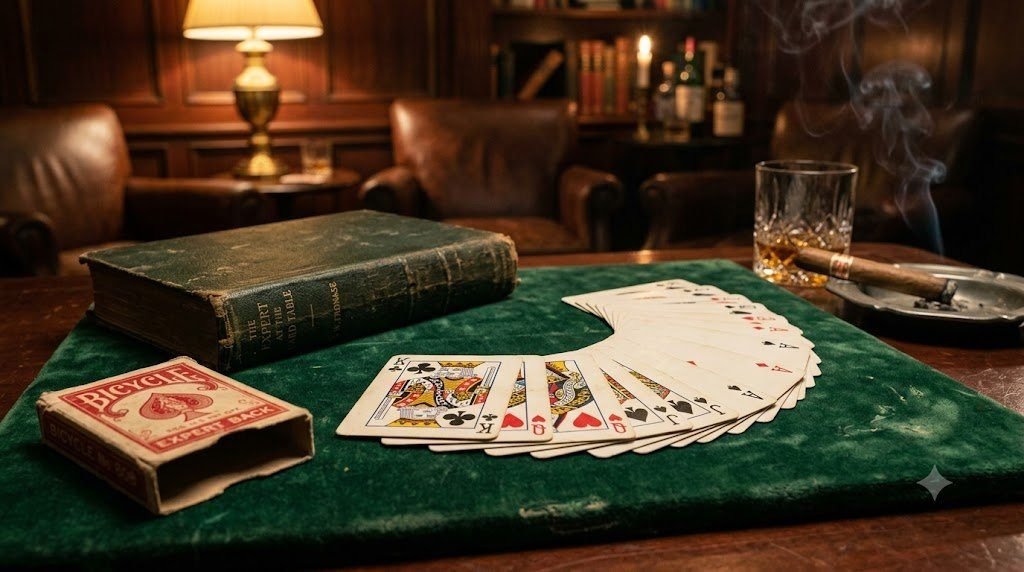
The Fifty-Two Pages of Paper: The Miniature Universe of Cartomancy
Among all the instruments invented by human civilization to play games of chance and fortune, none is more deceptively simple, mathematically rich, and endlessly fascinating than a standard pack of fifty-two playing cards. Comprising four suits reflecting the seasons, twelve court cards reflecting the months, and fifty-two cards mirroring the weeks of the solar year, a deck of cards is a miniature, tactile model of the cosmos. Yet in the hands of a master of prestidigitation, this humble pack of pasteboards transforms into an astonishing laboratory of applied physics, micro-mechanics, cognitive illusion, and sublime sleight of hand.
Close-up cartomancy—the performance of sleight-of-hand card magic performed inches away from the eyes of spectators—represents the most intimate, intellectually demanding, and technically refined branch of conjuring. Unlike grand stage illusions that rely on theatrical lighting, distance, and heavy machinery, close-up card prestidigitation operates in broad daylight, on an intimate felt table, with nowhere to hide. Every finger movement, muscular twitch, and fractional millisecond of timing is subjected to micro-inspection. In this definitive master treatise, we explore the golden foundations of close-up card mastery: the enigmatic literary monument ‘The Expert at the Card Table’ by S.W. Erdnase, and the immortal artistic revolution led by ‘The Professor’ himself, Dai Vernon.
🃏 Dai Vernon’s Supreme Maxim
‘Be natural. The moment you make a move that looks like a magician doing a secret sleight, you have failed. The hands must move with the effortless, relaxed grace of an innocent person handling ordinary objects.’
S.W. Erdnase and ‘The Expert at the Card Table’ (1902)
In the spring of 1902, a slim, emerald-green hardback book was self-published in Chicago under the title ‘Artifice, Ruse and Subterfuge at the Card Table: A Treatise on the Science and Art of Manipulating Cards’, authored by an unknown individual using the pseudonym ‘S.W. Erdnase’. Illustrated with over a hundred meticulous pencil drawings by graphic artist Marshall D. Smith, the book was divided into two distinct sections: ‘Card Table Artifice’ (a brutal, unvarnished manual of crooked gambling techniques—false shuffles, bottom dealing, center dealing, palming, and deck switches) and ‘Legerdemain’ (conjuring tricks and sleight-of-hand flourishes).
Erdnase’s book is universally revered by magicians as ‘The Bible’ of card prestidigitation. What made the text monumental was not merely its technical inventory of secret sleights, but its profound analytical philosophy. Erdnase was the first author to codify the biomechanics of card handling with scientific precision: articulating the necessity of uniform rhythm, identical hand postures between fair and fraudulent moves, and the psychological concept of ‘apparent’ vs. ‘actual’ action.
Yet for over 120 years, the true physical identity of S.W. Erdnase has remained the greatest unsolved mystery in conjuring history. The name is universally recognized as a backward anagram (spelling ‘E.S. Andrews’ in reverse). Magical detectives and historians—including Martin Gardner, Richard Hatch, and David Alexander—have dedicated entire lifetimes to the hunt, proposing candidates such as crooked gambler Wilbur Edgerton Sanders, con man Milton Franklin Andrews, and clockmaker Edwin Sumner Andrews. To this day, the true author of the greatest card manual in history remains an anonymous ghost.
| Foundational Card Sleight | Erdnase / Vernon Codification | Anatomical Grip & Mechanics | Primary Function / Illusion | Technical Difficulty Index |
|---|---|---|---|---|
| The Classic Pass (Sautoir) | Erdnase / Charlier | Dual-packet transposition under cover of squaring | Covertly relocates chosen card from center to top | 10 / 10 (Requires years of micro-muscle training) |
| The Bottom Deal | Erdnase (Chapter 1) | Modified mechanic’s grip & ring-finger snap | Deals bottom card while appearing to deal from top | 9.5 / 10 (Zero neck movement, identical cadence) |
| The Second Deal | Erdnase / Charlie Miller | Thumb glide & strike/push-off coordination | Retains top force card while dealing next card | 9 / 10 (Acoustic and visual rhythm must match) |
| The Palm (Top / Bottom) | Erdnase Diagonal Palm Shift | Tenkai / Erdnase pinky-pivot into longitudinal palm | Steals card invisibly into hollow of hand | 8.5 / 10 (Absolute muscular relaxation required) |
| The Double Lift | Dai Vernon / Al Baker | Slight beveling & two-card turnover as single unit | Displays second card while spectator believes it’s top | 7.5 / 10 (Must look completely casual and natural) |
Dai Vernon: The Professor Who Fooled Houdini
If Erdnase was the anonymous prophet of card mechanics, David Frederick Wingfield Verner—known globally as Dai Vernon, or affectionately as ‘The Professor’ (1894–1992)—was its messiah. Born in Ottawa, Canada, Vernon discovered Erdnase’s book at the age of seven and dedicated his life to purifying the art of close-up prestidigitation.
Vernon achieved international legendary status in 1919 at the Great Northern Hotel in Chicago. Harry Houdini, then at the height of his international fame, had publicly boasted that no magician could deceive him if he was permitted to watch a trick performed three times in succession. Vernon accepted the challenge. Performing his refined version of ‘The Ambitious Card’, Vernon took an ordinary playing card, signed it, pushed it fairly into the middle of the deck, and without any suspicious movements, tipped the top card face-up: the signed card was back on top! Houdini demanded to see it again. Vernon repeated the effect—not three times, but seven times in a row! Houdini sat in stunned, furious silence, unable to detect the method. From that fateful evening onward, Vernon was billed across the magical world as ‘The Man Who Fooled Houdini’.
The Vernon Revolution: The Pursuit of Naturalness
Prior to Dai Vernon, European card conjuring was dominated by stiff, affected, and theatrical flourishes: magicians held cards with pinched fingertips, made dramatic snapping sounds, and executed florid, unnatural hand contortions that screamed to the audience that a secret manipulation was occurring. Vernon demolished this entire aesthetic.
Vernon’s revolutionary insight was that deception succeeds only when it is indistinguishable from the ordinary. He spent hours watching non-magicians handle cards in casual poker games, studying how an ordinary person shuffles, cuts, and deals. He then redesigned every classic sleight—the Double Lift, the Pass, the Palm, the False Cut—so that the hands moved with absolute physical relaxation, adopting the same casual, unhurried posture as an everyday card player. In monumental works such as ‘The Dai Vernon Book of Magic’ (1956) and ‘Inner Secrets of Card Magic’ (penned by Lewis Ganson), Vernon elevated close-up magic into an aristocratic fine art.
The Ambitious Card and the Geometry of the Double Lift
Among all routines in close-up cartomancy, ‘The Ambitious Card’ stands as the ultimate proving ground for a master prestidigitator. The plot is deceptively simple: a chosen card is signed with permanent ink by a spectator, pushed into the dead center of the deck, and through various magical gestures, repeatedly rises to the top of the pack.
What makes the Ambitious Card immortal is its modular, jazz-like structure. A master performer can weave together dozens of different mechanical and psychological principles: the Double Lift (turning over two cards as one to display the target card, while the physical card placed into the center is an indifferent card), the Tilt (placing a card into a hidden break beneath the top card while visually appearing to push it into the middle), the Pass (a secret, split-second transposition of the two halves of the deck), and the Pop-Up Move. Because the effect repeats with escalating conditions of impossibility—binding the deck with rubber bands, placing the deck under a clear glass, or having the card rise to the top while sticking out face-up—the routine systematically demolishes every logical hypothesis the spectator constructs.
The Modern Renaissance: From Expert Card Tables to Digital Mastery
In the twenty-first century, the legacy of S.W. Erdnase and Dai Vernon has exploded into an international renaissance of close-up prestidigitation. Master technicians such as Ricky Jay, René Lavand (the legendary one-armed Argentine master who performed miracles with pure poetry), Juan Tamariz, and Lennart Green have demonstrated that fifty-two pieces of printed cardboard can captivate the world’s most sophisticated audiences.
Furthermore, the modern Cardistry movement—championed by virtuosos like the Buck twins (Dan and Dave) and the Singaporean collective Virtuoso—has spun off cartomancy into a breathtaking visual kinetic art form. Cards are fanned, aerial-cut, flipped, and spun in zero-gravity geometric ballets, celebrating the physical beauty and balance of the pasteboards. Whether executed as an impenetrable gambling demonstration, an intimate emotional poem, or a kinetic visual flourish, close-up cartomancy remains an immortal testament to the boundless limits of human manual dexterity and creative imagination.
Conclusion: The Poetry of Pasteboard
To watch a true master of close-up cartomancy is to witness one of the purest expressions of artistic dedication known to human culture. In an era dominated by computer screens, virtual simulations, and artificial intelligence, the intimate magic of a physical pack of cards held in living hands provides an irreplaceable touchstone of authentic human connection. In the quiet shuffle, the gentle snap, and the impossible emergence of a signed card, we are reminded of the exquisite potential of human craft—a craft that transforms fifty-two scraps of paper into an eternal gateway to wonder.
The Vernon Touch: Why Lewis Ganson’s Chronicles Changed Conjuring
The monumental legacy of Dai Vernon was preserved for eternity through the literary collaboration between Vernon and British magical author Lewis Ganson. In landmark volumes such as ‘The Dai Vernon Book of Magic’ (1956), ‘Inner Secrets of Card Magic’ (1959), and ‘More Inner Secrets of Card Magic’ (1960), Ganson captured what the magic fraternity universally terms ‘The Vernon Touch’.
Before these books, magic instructional texts were dry, mechanical inventories of finger placements: ‘Place finger A on corner B and push card C.’ Vernon and Ganson revolutionized magical pedagogy by explaining the ‘why’ behind every move: the psychological rhythm, the direction of gaze, the subtle tilt of the wrist, and the precise moment of muscular relaxation. Vernon demonstrated that the difference between an amateur and a master is not the move itself, but the thousand invisible nuances that surround it. The Vernon Chronicles remain the definitive textbooks studied by every serious student of close-up prestidigitation across the globe.
René Lavand and the Metaphor of ‘No Se Puede Hacer Más Lento’
In the pantheon of close-up cartomancy, no figure occupies a more poetic and inspiring position than Argentine master René Lavand (1928–2015). At the age of nine, Lavand lost his entire right arm below the elbow in a tragic automobile accident. Refusing to abandon his dream of card prestidigitation, Lavand accomplished the seemingly impossible: he completely re-engineered classical two-handed card mechanics into a revolutionary, one-handed close-up art form.
Seated at an intimate baize table, Lavand handled cards with a slow, deliberate, and hypnotic elegance that defied explanation. In his signature routine, ‘It Cannot Be Done Slower’ (No Se Puede Hacer Más Lento), Lavand performed an Oil and Water routine (alternating red and black cards separating magically), announcing with aristocratic gravitas that he would execute the trick with complete slowness, so the audience could catch him. Yet even at a glacial pace, using only five fingers of his left hand, the cards separated effortlessly. Lavand proved that true mastery does not require speed or two hands; it requires soul, poetry, and an unbreakable devotion to artistic beauty.
The Mathematics of the Faro Shuffle: Deterministic Chaos in 52 Cards
Among the most profound mathematical discoveries in cartomancy is the properties of the ‘Faro Shuffle’ (or weave shuffle), codified by mathematician Persi Diaconis (himself a former sleight-of-hand disciple of Dai Vernon) and card mechanic Ed Marlo. A perfect Faro shuffle requires the performer to cut a 52-card deck into two exact packets of twenty-six cards, and weave the cards together such that the cards interlace in absolute 1-to-1 alternating succession.
Mathematicians proved that this mechanical operation is not randomizing; it is completely deterministic permutation. If a performer executes eight consecutive ‘Out-Faros’ (where the original top and bottom cards remain in place), the fifty-two cards undergo a closed mathematical cycle and return precisely to their original starting factory order! Furthermore, by calculating binary powers, a card master can use Faro shuffles to move any chosen card to any predetermined position in the deck from 1 to 52, transforming the deck into a binary mechanical computer disguised as a casual shuffle.
Alex Elmsley and the Four-as-Four Ghost Count
In 1954, British civil servant and amateur card mathematician Alex Elmsley invented what is universally recognized as the most widely used false count in the history of card prestidigitation: ‘The Elmsley Count’ (originally termed the Ghost Count). Designed for his classic packet trick ‘The Four Card Trick’, the Elmsley count allows a performer to cleanly count four cards from hand to hand, displaying four card backs or four card faces, while completely concealing one of the four cards from view.
The move relies on a synchronized push-off: as the right hand takes the first card, the left thumb pushes off two cards as a single block on the count of ‘two’, while the right hand secretly slips the first card back beneath the packet. The visual and acoustic rhythm of the count is completely uniform, mimicking an innocent, fair count with zero hesitation. The Elmsley Count spawned an entire genre of ‘packet tricks’—miniature card masterworks performed with only four or five cards—proving that monumental card magic does not require a full deck, but can be achieved through pure mathematical and mechanical elegance.