The Spectral Science: When Victorian Physics Summoned Phantoms
During the mid-nineteenth century, Victorian London was gripped by a profound cultural obsession with spiritualism, gothic phantoms, and spectral apparitions. Theater producers and playwrights desperately sought staging technologies capable of presenting realistic, translucent ghosts that could appear and dissolve upon the physical stage in full view of audiences, interacting seamlessly with living actors while remaining invulnerable to physical weapons. Painted gauze scrims, lantern slides, and magic lantern projections were crude, flat, and obvious, immediately recognized by audiences as two-dimensional projections.
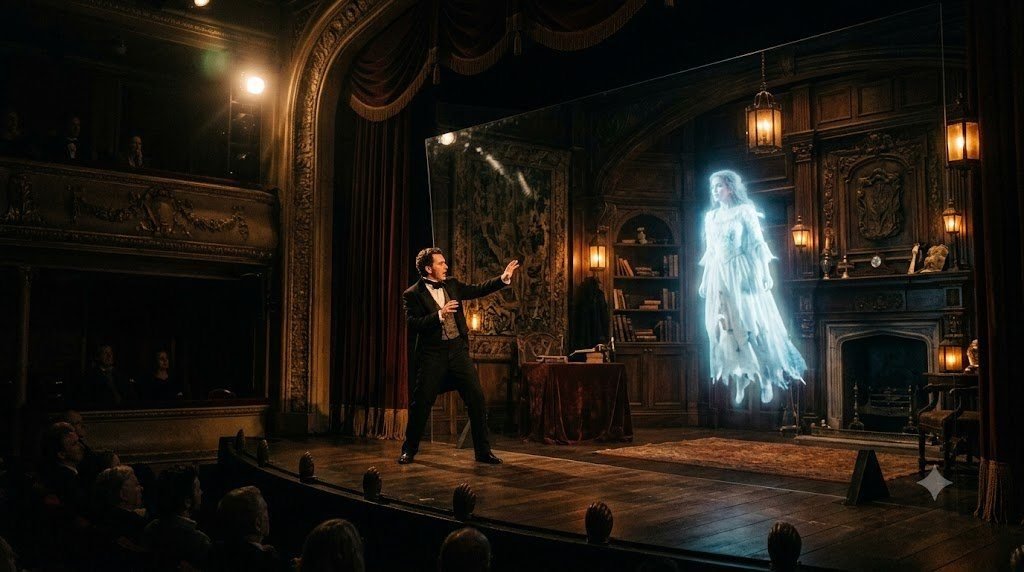
The breakthrough that forever revolutionized theatrical illusions arrived on Christmas Eve, 1862, at the Royal Polytechnic Institution on Regent Street in London. British civil engineer Henry Dircks and analytical chemist Professor John Henry Pepper unveiled a breathtaking demonstration: a dramatic staging of Charles Dickens’s ‘The Haunted Man’. Before an astonished audience, a glowing, three-dimensional translucent phantom appeared standing center stage alongside live actors. The live actors could walk around the ghost, thrust swords directly through its glowing torso without resistance, and watch the apparition fade into thin air with cinematic smoothness.
This legendary optical apparatus, forever christened ‘Pepper’s Ghost’, represents one of the most brilliant and enduring marriages of classical geometric optics, specular reflection physics, and theatrical stage engineering in human history. From nineteenth-century Victorian playhouses to modern holographic concerts featuring Tupac Shakur and Michael Jackson, to Disney’s iconic Haunted Mansion ballroom, Pepper’s Ghost remains the undisputed king of specular illusions.
👻 Key Optical Principle: The Fresnel Reflection Equations
Pepper’s Ghost relies on the Fresnel equations governing partial reflection and transmission. When light strikes a transparent dielectric boundary (such as float glass) at an angle, a fraction of the light reflects specularly while the remainder transmits through. By balancing illumination levels between stage and pit, the glass acts as a seamless beamsplitter.
The Classical Architecture of the Dircks-Pepper Apparatus
The mechanical and optical configuration of the original Pepper’s Ghost apparatus is a masterclass in geometric simplicity and physical elegance. The staging requires two distinct spatial chambers: the main stage where the audience looks, and an auxiliary hidden chamber termed the ‘Blue Room’ (or orchestra pit).
Between the audience and the main stage, an immense, seamless sheet of high-quality polished plate glass is erected, angled precisely at forty-five degrees relative to both the stage floor and the audience’s line of sight. To the audience seated in the darkened auditorium, this glass sheet is virtually invisible: because the edges are concealed behind stage velvet proscenium arches and the auditorium is dark, no specular glare reflects from the front surface.
Directly beneath the stage floor, situated in the hidden orchestra pit, lies the secondary ‘Blue Room’. This hidden chamber is lined entirely in light-absorbing matte black velvet. Inside this chamber stands an actor dressed in a glowing white ghost costume. A high-intensity directional illumination source—originally lime-light burners (calcium oxide heated to incandescence by oxy-hydrogen gas blowpipes) or carbon arc lamps—is directed onto the hidden actor.
According to the law of specular reflection, the angle of incidence equals the angle of reflection. When the limelight in the hidden pit is slowly dialed up, light rays reflecting off the hidden actor travel upward toward the angled glass sheet. The glass acts as a partial mirror (a beamsplitter): roughly eight to ten percent of the light reflects off the front and rear surfaces of the glass directly into the eyes of the audience. To the observers, the reflected rays are perceived as originating from behind the glass, at a virtual distance exactly equal to the physical distance between the hidden actor and the glass. The ghost appears to materialize standing solidly in the center of the main stage!
| Era / Application | Technological Platform | Illumination Source | Reflective Medium | Notable Masterpiece / Showcase |
|---|---|---|---|---|
| Victorian Theater (1862) | Dircks-Pepper Apparatus | Oxy-hydrogen Limelight burners | Heavy plate glass (45° angle) | Charles Dickens’s ‘The Haunted Man’ at Royal Polytechnic |
| Dark Ride Amusement (1969) | Disney Haunted Mansion Ballroom | High-output theatrical tungsten spots | Dual-story 30-foot plate glass panels | Ghostly waltzing dancers and banquet dining specters |
| Modern Concert ‘Hologram’ (2012) | Digital Projection Beamsplitter | Ultra-high-lumen digital laser projectors | Mylar foil / polymer film (Eyeliner system) | Tupac Shakur at Coachella & Michael Jackson Billboard Awards |
| Automotive HUD (Modern) | Heads-Up Dashboard Displays | Micro-OLED & Laser beam scanners | Windshield polyvinyl butyral (PVB) interlayer | Speedometer and AR navigation projected onto asphalt road |
| Teleprompter / Broadcast | Camera Lens Beamsplitter | High-contrast LCD text monitor | Half-silvered 70/30 optical glass | News anchors reading text looking directly into camera lens |
Disney’s Masterpiece: The Haunted Mansion Ballroom (1969)
The grandest, most permanent, and technically ambitious deployment of Pepper’s Ghost in the world resides inside the Ballroom scene of Walt Disney’s Haunted Mansion attraction at Disneyland and Walt Disney World, engineered by legendary Disney Imagineer Yale Gracey.
As guests glide past an elevated mezzanine balcony in their ‘Doom Buggies’, they gaze down into a grand, decaying banquet hall where translucent Victorian ghosts waltz gracefully across the floor, sit at a dining table blowing out birthday candles, and swing from crystal chandeliers. The scale of the illusion is monumental: the glass panels used in the attraction measure an astounding thirty feet tall by ninety feet wide, requiring special cranes and structural building engineering during construction.
Gracey’s technical genius was the dual-level design. The moving animatronic figures are not hidden beneath the guests; they are located directly above and below the viewing track in darkened mezzanine galleries. The animatronic waltzers are mounted on rotating turntables beneath the guests, illuminated by automated spotlights that cycle in synchronization with the music. Because the glass spans the entire length of the hall without mullions or seams, the ghosts appear to float in true stereoscopic, three-dimensional space, proving that Victorian optics could outmatch twentieth-century cinema.
From Victorian Glass to Modern ‘Holographic’ Concerts
In the twenty-first century, media headlines frequently herald the arrival of ‘3D Holograms’ resurrecting deceased musicians for live arena concerts. When rapper Tupac Shakur stunned the world by performing live alongside Snoop Dogg and Dr. Dre at the 2012 Coachella Music Festival, media outlets worldwide celebrated it as a breakthrough in quantum holographic technology.
In physical reality, the Tupac concert did not utilize holography at all; it was a pure, unadulterated execution of Pepper’s Ghost, deployed using modern digital assets. Instead of a heavy, fragile sheet of plate glass, the production utilized an ultra-thin, highly transparent polyester polymer film known commercially as ‘Musion Eyeliner’ or ‘Cheoptics360’. The foil was tensioned across the front of the stage at a forty-five-degree angle with hydraulic stretchers, rendering it invisible under stage lighting.
A digital projection rig—utilizing three synchronized 42,000-lumen Christie digital laser projectors—beamed a high-resolution, computer-generated animation of Tupac downward onto a matte white reflective bounce screen laid horizontally in the orchestra pit. The image reflected off the horizontal screen onto the angled Musion foil, beaming directly into the retinas of sixty thousand screaming festival attendees. By synchronizing the virtual projection with live stage lighting, live backup singers, and real-time stage shadows, the production created the uncanny illusion that a fallen legend had stepped out of the grave.
🔬 Technical Insight: Why Polymer Foil Replaced Glass
Plate glass is heavy (weighing hundreds of pounds per sheet), fragile, and produces a faint double image (ghosting) due to reflections from both front and back surfaces. Modern Musion foil is only tenths of a millimeter thick, virtually eliminating double refraction while enabling portable touring.
The Physics of Specular Refraction and Beamsplitter Coatings
At the fundamental level of physical optics, Pepper’s Ghost operates under Snell’s Law and Fresnel reflection coefficients. When an electromagnetic light wave traveling through air (refractive index n ≈ 1.00) encounters a dielectric sheet of glass (n ≈ 1.52), the impedance mismatch causes a portion of the wave to bounce back into the first medium (specular reflection), while the remainder transmits through the glass (refraction).
For untreated glass at a 45-degree angle of incidence, roughly 4% of light is reflected from the front surface, and roughly 4% is reflected from the back surface, yielding a total reflectance of approximately 8 to 9%. While this is sufficient for a ghostly, translucent apparition, modern optical engineering utilizes ‘half-silvered’ dielectric coatings (beam splitters). By applying nanometer-thin vapor depositions of metallic titanium dioxide or aluminum, engineers can fine-tune the reflection-to-transmission ratio to precisely 50/50 or 70/30, enabling crystal-clear Heads-Up Displays (HUDs) on modern fighter jet canopies and automotive luxury windshields.
Conclusion: The Immortality of Specular Wonder
More than a century and a half after John Henry Pepper startled Victorian London with his spectral phantoms, Pepper’s Ghost remains a cornerstone of visual wonder. It demonstrates that the most transcendent illusions do not require digital processing, microchips, or artificial intelligence; they emerge from the timeless geometry of light, reflection, and human perception. In the simple meeting of angled glass and dancing photons, science transforms into pure theatrical magic, granting humanity the power to conjure dreams upon the physical stage.
The Metempsychosis: Optical Morphing and Living Skeletons
Following the international sensation of the original Pepper’s Ghost in 1862, John Henry Pepper and French illusionist Henri Robin developed an astonishing optical evolution termed ‘The Metempsychosis’ (or The Transformation). While standard Pepper’s Ghost presented a fixed, translucent phantom standing in empty space, the Metempsychosis allowed a living, breathing human actor to visibly and smoothly transform into a decaying skeleton or a stone statue before the audience’s eyes.
The apparatus achieved this optical dissolve through counter-balanced cross-fade illumination. The living actor stood on the main stage behind an angled glass plate, illuminated by adjustable limelight burners. Directly in the hidden reflection pit stood an identical pedestal holding an anatomically articulated human skeleton, positioned at the exact virtual spatial coordinates. By slowly dimming the stage lights illuminating the living actor while simultaneously brightening the lime-light illuminating the skeleton in the pit, the reflected image of the skeleton gradually overwhelmed the diminishing transmitted image of the human. The flesh appeared to melt away from the bones in a continuous optical dissolve, decades before Hollywood invented digital morphing algorithms.
Modern Teleprompters and Studio Beamsplitters
While nineteenth-century audiences marveled at ghosts, twentieth-century television broadcast journalism transformed Pepper’s Ghost into an indispensable daily technology: the Teleprompter. Invented by Hubert Schlafly and Fred Barton in the 1950s, the modern studio teleprompter positions a high-brightness flat-panel LCD monitor horizontally beneath the television studio camera lens.
A specialized, coated half-silvered beamsplitter mirror (typically 70% transmission, 30% reflection) is mounted directly in front of the camera lens at a 45-degree angle. The scrolling text on the horizontal monitor reflects off the glass directly into the news anchor’s eyes, allowing them to read full news scripts with complete fluency. Crucially, because the rear surface of the glass transmits seventy percent of incoming light straight through to the camera sensor, the camera films the anchor looking directly down the center of the lens axis. Millions of viewers perceive the anchor gazing intently into their living rooms, completely unaware that an optical ghost of scrolling text is hovering between the camera and the presenter’s face.
Augmented Reality and Head-Mounted Optical Waveguides
In the twenty-first century, the foundational principles of John Henry Pepper have transitioned from Victorian theater stages directly onto the human face. In advanced augmented reality (AR) optical headsets such as Microsoft HoloLens, Magic Leap, and modern smart glasses, engineers utilize diffractive optical waveguides and nanoscale surface-relief gratings that operate as microscopic, computerized Pepper’s Ghost beamsplitters.
Digital micro-displays project synthetic photons into the edge of a transparent glass or polymer lens. Total internal reflection (TIR) channels the light waves through the glass until they strike microscopic diffractive gratings positioned directly in front of the wearer’s pupils. These gratings out-couple the virtual photons, reflecting computer-generated 3D graphics, holographic interfaces, and architectural wireframes directly onto the wearer’s retina while simultaneously transmitting ambient natural light from the real world. The wearer perceives digital holograms floating solidly atop physical desks and walls—a direct technological descendant of Dickens’s ghostly stage apparitions.
Museum Dioramas and Dark Ride Narrative Immersion
Beyond live stage theater, Pepper’s Ghost has become a foundational tool in global museum exhibition design and theme park dark rides. In cultural heritage museums, curators utilize angled beamsplitters to bring historical artifacts to life: a visitor gazing into a glass display case containing an ancient roman dagger sees the ghostly, translucent hand of a gladiator reach out and grasp the weapon, before dissolving into thin air. Because the illusion requires no goggles, headsets, or 3D glasses, it provides a completely natural, accessible, and collective emotional experience for visitors of all ages, proving that the magic of classical reflection optics remains as captivating today as it was in 1862.