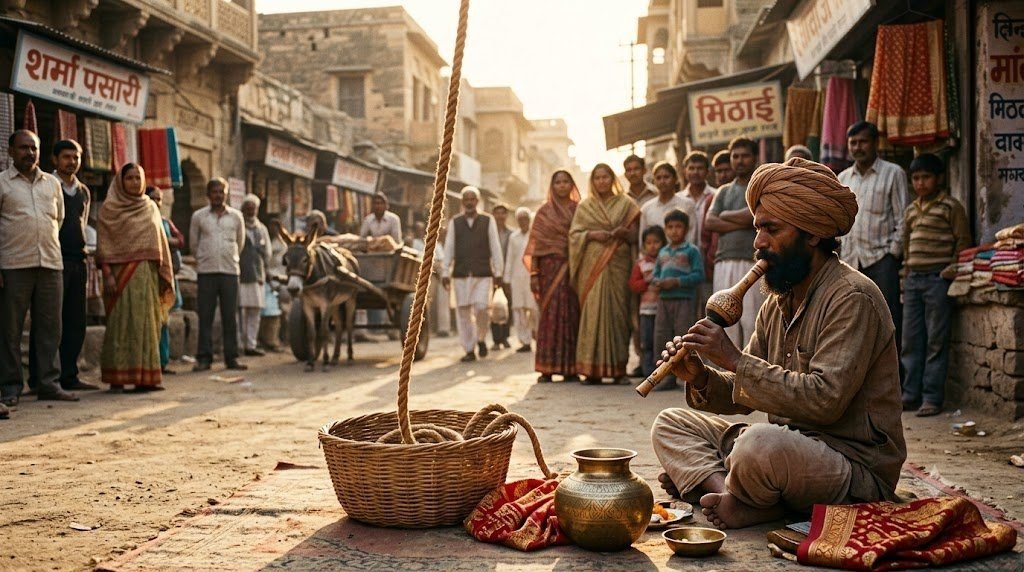
The Subcontinental Tradition: Street Conjuring as Hereditary Guild
For millennia, the Indian subcontinent has occupied a mythic, singular status in the global imagination as the ancestral cradle of mysticism, spiritual miracles, and sublime conjuring arts. While European magic developed largely inside gilded aristocratic drawing rooms and Victorian mechanized theaters, Indian illusionism flourished in the dusty, vibrant open-air public squares, bustling village bazaars, and roadside clearings across Rajasthan, Bengal, and Uttar Pradesh. Known vernacularly as ‘Jadugars’ or ‘Madaris’, traditional Indian street performers belonged to hereditary, itinerant castes (such as the Nath or Qalandar communities) whose secret techniques, performance scripts, and mechanical apparatuses were guarded with sacred reverence, passed down strictly from father to son across dozens of generations.
Unlike Western stage magicians who relied on dark velvet drapes, stage trapdoors, optical mirrors, and complex counterweighted mechanical hoists, the Indian street conjurer operated under what Western performers considered physically impossible conditions: performing in broad, glaring tropical daylight, on bare, uncarpeted dirt ground, completely surrounded on all 360 degrees by a circle of skeptical onlookers, clad in nothing more than a simple cotton dhoti or loincloth and a turban. In this raw, visceral environment, Indian performers developed an extraordinary mastery of pure misdirection, acoustic crowd psychology, sleight of hand, and organic folk mechanics that baffled colonial British officers, scholars, and traveling Western conjurers for centuries.
🪘 Historical Axiom: The Madari Circle of Deception
The Indian street performer’s primary weapon is the ‘Ghera’ (the performance circle). By beating a hypnotic handheld damru drum, shouting rhythmic incantations, and throwing powder into the air, the Jadugar manipulates the collective psychology of the crowd, turning ordinary street dust into an impenetrable wall of misdirection.
The Indian Rope Trick: The Greatest Myth in Magic History
No illusion in the global history of conjuring has generated more passionate debate, intense academic investigation, and worldwide astonishment than the legendary ‘Indian Rope Trick’. According to the classic nineteenth-century traveler’s tale, an itinerant fakir sits before an open-air crowd and tosses a heavy coil of coarse hemp rope into the clear blue sky. Instead of falling back to earth, the rope remains standing vertically rigid in mid-air, suspended by some unseen cosmic force, its top end disappearing into the clouds.
The fakir then commands his young boy assistant (the ‘chela’) to climb the rigid rope. The boy ascends hand over hand until he too disappears into the empty sky. Moments later, after shouting angry commands up the rope, the fakir draws a curved scimitar sword, places it between his teeth, and climbs the rope after the boy. Terrified screams echo from the clouds, and suddenly, severed human limbs—arms, legs, a bleeding torso, and a severed head—tumble down from the sky, landing heavily in the dirt. The fakir slides back down the rope, gathers the bloody severed body parts into a woven wicker basket, and covers it with a cloth. After chanting prayers, the fakir taps the basket with his wand; the basket lid flies open, and the young boy leaps out completely whole, unharmed, and smiling, to the rapturous applause of the stunned crowd.
For decades, prominent Western magical institutions—including London’s The Magic Circle and the Occult Committee—offered colossal cash rewards (such as £5,000, equivalent to hundreds of thousands of pounds today) to any performer who could demonstrate the Indian Rope Trick in open daylight. Not a single person ever claimed the prize. Extensive historical investigations by magical historians John Keel and Peter Lamont revealed the astonishing truth: the full, mythical version of the Indian Rope Trick was never an actual physical street trick at all! It was a sensational, fabricated hoax written by journalist John Elbert Wilkie and published in the Chicago Daily Tribune on August 8, 1890, as a creative fiction that swept across global newspapers, transforming into an enduring international myth.
| Traditional Indian Illusion | Vernacular Name | Performance Environment | Primary Secret Mechanism | Cultural Significance |
|---|---|---|---|---|
| The Mango Tree Mystery | Aam Ka Ped | Bare outdoor ground, surrounded by crowd | Nested cloth tenting & vegetative substitution | Symbolizes agricultural fertility & divine life cycle |
| The Indian Basket Trick | Chhatri / Tokri Ka Khel | Wicker basket on open dirt, broad daylight | Contortion inside perimeter edge & curved sword angles | Archetypal sacrificial death and resurrection ritual |
| Cups and Balls (Indian Style) | Gili-Gili / Katori Khel | Seated cross-legged on floor using shallow brass cups | Thumb-palm sleights & large cloth lap loading | Ancestor of Western table conjuring; supreme dexterity |
| The Diving Duck / Water Spout | Pani Ka Khel | Terracotta pots and hollow bamboo reeds | Atmospheric hydrostatic pressure & siphon tubes | Ancient hydraulic science preserved in folk performance |
| Pulse Stopping (Fakir) | Nadi Rokna | Close physical examination by medical doctors | Axillary pressure with wooden crutch (khapra) | Demonstrates mastery over autonomic nervous system |
The Mango Tree Mystery: Organic Botanical Deception
While the full Rope Trick was a literary myth, ‘The Mango Tree Mystery’ was an undisputed, universally documented physical reality that stunned Western observers across centuries, including Mughal Emperor Jahangir, who documented it in his seventeenth-century memoirs ‘Tuzk-e-Jahangiri’. In this astonishing performance, a street Jadugar displays a dry, barren mango seed. He plants the seed into a mound of earth on the ground, waters it from a brass vessel, and covers the mound with a three-legged cloth tripod or tent.
Over the course of thirty to forty minutes, while performing other minor sleights to pass the time, the performer repeatedly lifts the cloth covering to show progress. Within minutes, the dry seed sprouts a green shoot. Minutes later, the shoot grows into a small sapling with leaves. By the end of the performance, the cloth is removed to reveal a mature, miniature mango bush standing two to three feet tall, complete with fragrant blossoms and fresh, ripe mango fruit, which the Jadugar cuts and distributes to the crowd to eat!
The secret of the Mango Tree Trick is a masterwork of patience, textile mechanics, and natural materials. The performer utilizes fresh mango tree branches harvested immediately prior to the performance, whose stems are carefully rolled and coiled tightly like clockwork springs inside the hollow hem of the Jadugar’s expansive cotton sheet or concealed inside the folds of the cloth tripod. As the performer repeatedly waters the mound and adjusts the cloth cover with elaborate, dramatic flourishes, his hands execute lightning-fast vegetative substitutions, unfurling larger and larger branches and pinning fresh fruit to the stems, proving that theatrical misdirection can compress biological months into minutes.
The Indian Basket Trick: The Living Resurrection
Perhaps the most visceral and dramatically thrilling street illusion in India is ‘The Basket Trick’ (Tokri Ka Khel). A large, oval woven wicker basket—resembling a traditional laundry hamper with an inward-tapered neck and a lid—is placed on the bare ground. A young boy assistant is tied into a cotton sack and placed inside the basket. The lid is pressed down tightly, and a heavy rope or cloth is lashed across the top.
The Jadugar, feigning a sudden burst of demonic fury, draws a long, razor-sharp steel sword. To the horror of the spectators, he plunges the sword violently into the basket from every possible direction—thrusting through the top, the sides, and the base, until the blade passes completely through the basket. Blood frequently appears dripping from the wicker weave. The crowd gasps as the performer steps into the basket, jumping up and down inside the empty container, flattening it to the ground to prove that nothing solid remains within.
The performer steps out, removes the sword, covers the flattened basket with a large cloth, and plays his pungi flute. Slowly, the basket begins to expand. The cloth is whipped away, the lid is opened, and the boy steps out completely unharmed, laughing joyfully. The physical secret of the basket trick is a triumph of human contortion. The wicker basket is constructed with an oval, bulging perimeter that creates a hidden annular cavity around its interior base. The flexible young boy does not remain in the center; the moment the lid is closed, he slips his torso around the curved inner perimeter, curling his body into a horseshoe ring. The performer knows the exact angles along which to thrust the sword, passing the steel safely through the central void while carefully missing the boy, creating an unforgettable theatrical masterpiece of life, death, and resurrection.
The Cross-Legged Cups and Balls: The Gili-Gili Masters
While Western conjurers performed the Cups and Balls standing behind elevated tables with hidden servantes and pouches, Indian Jadugars performed the routine seated cross-legged directly on the bare dirt ground. Using shallow, bowl-like brass cups and small cloth balls made of wound fabric (termed ‘gili-gili’), these street masters achieved a level of manual dexterity and psychological timing that stunned European visitors.
Because the performer was seated on the ground with their knees spread wide, their cotton dhoti created a natural, massive catchment cloth across their lap. While executing fluid, rhythmic passes with their right hand, the performer’s left hand constantly loaded and unloaded balls, lemons, and live chicks from the lap with imperceptible speed. The hypnotic rhythm of the damru drum and the continuous, rapid verbal patter served as an auditory misdirection blanket, proving that great sleight of hand requires no furniture, no elevated staging, and no mechanical apparatus.
Conclusion: The Living Heritage of Street Wonder
The ancient traditions of Indian street magic represent an irreplaceable jewel in humanity’s shared cultural heritage. In the dusty crossroads of the subcontinent, these hereditary masters preserved and perfected the fundamental psychology of deception, demonstrating that true magic does not reside in expensive props or digital technology, but in the intimate relationship between the performer, the story, and the human heart. As modern urbanization and legal restrictions threaten traditional street performance castes, documenting and celebrating their timeless art is essential to honoring the deep, ancestral roots of global illusionism.
The Diving Duck and Hydrostatic Folk Mechanics
Beyond botanical and contortionist wonders, the Indian street repertoire featured astonishing demonstrations of applied fluid dynamics and hydrostatic pressure, most notably the ‘Diving Duck’ (Pani Ka Khel). The performer would present a large terracotta or copper water vessel filled to the brim. Floating on the surface was a small wooden or clay duck. With a simple verbal command, the Jadugar could cause the duck to submerge to the bottom of the vessel, hover motionless midway through the water column, or slowly ascend to the surface on command, stopping at any depth indicated by an audience spectator.
While the performance was framed as an acoustic dialogue between the Jadugar and the spirit of the duck, the secret rested upon the physics of the Cartesian diver, constructed entirely from primitive rural materials. The hollow duck contained a small air bubble and a tiny aperture at its base. The Jadugar held the vessel with both hands, his thumbs pressing against a concealed, flexible animal membrane or rubber-sealed puncture hole located beneath the decorative wicker wrap of the pot. By subtly tensing his thumb muscles, the Jadugar increased the internal hydrostatic pressure inside the vessel, forcing water into the duck and compressing the internal air bubble. This increased the duck’s average density above that of water, causing it to sink. Releasing thumb pressure allowed the air to expand, restoring buoyancy. It was a flawless demonstration of seventeenth-century Archimedean physics preserved as ancient street theater.
The Pulse-Stopping Fakir: Autonomic Deception
Perhaps no demonstration caused greater alarm among colonial European military surgeons than the fakir’s apparent ability to halt their own heartbeat at will. In formal demonstrations before Western physicians, an Indian fakir would permit two doctors to place their fingers firmly upon the radial pulses in both of his wrists, or place stethoscopes directly against his chest. Upon entering a deep meditative trance, the fakir would exhale slowly, and within moments, the pulse in his left wrist would gradually weaken, flutter, and cease completely for thirty to sixty seconds, before surging back to full vigor on command.
While medical observers initially theorized that the fakir possessed superhuman neuro-muscular control over their vagus nerve and cardiac pacemaker nodes, forensic investigations revealed an ingenious physical secret. The fakir leaned forward, casually placing his upper arm against a small wooden meditation crutch (a ‘khapra’) or tucking a hard cloth ball firmly into his armpit (axilla). By contracting the pectoralis major and latissimus dorsi muscles, the fakir compressed the axillary and brachial arteries against the humeral bone. This completely occluded blood flow to the forearm and wrist, extinguishing the palpable radial pulse, while the heart continued beating normally inside the chest, demonstrating how physiological knowledge was weaponized to simulate miraculous bodily mastery.
Colonial Encounters: The West’s Search for Subcontinental Sorcery
During the peak of the British Raj in the nineteenth and early twentieth centuries, the fascination with Indian street magic reached obsessive heights among British colonial administrators, officers, and visiting intellectuals. Scores of colonial memoirs, from Captain P.C. Sorcar’s historical surveys to traveler accounts by Louis Jacolliot, reported miraculous street feats that seemed to defy Western rationalism. The British Empire, with its industrial steel railways, telegraph lines, and steamships, felt intellectually unsettled by the spectacle of an illiterate street performer in rags casually creating what appeared to be biological and physical impossibilities on a dirt road. This colonial anxiety fueled massive rewards, academic debates, and a profound cultural exchange that permanently transformed both Western stage magic and traditional Indian conjuring.