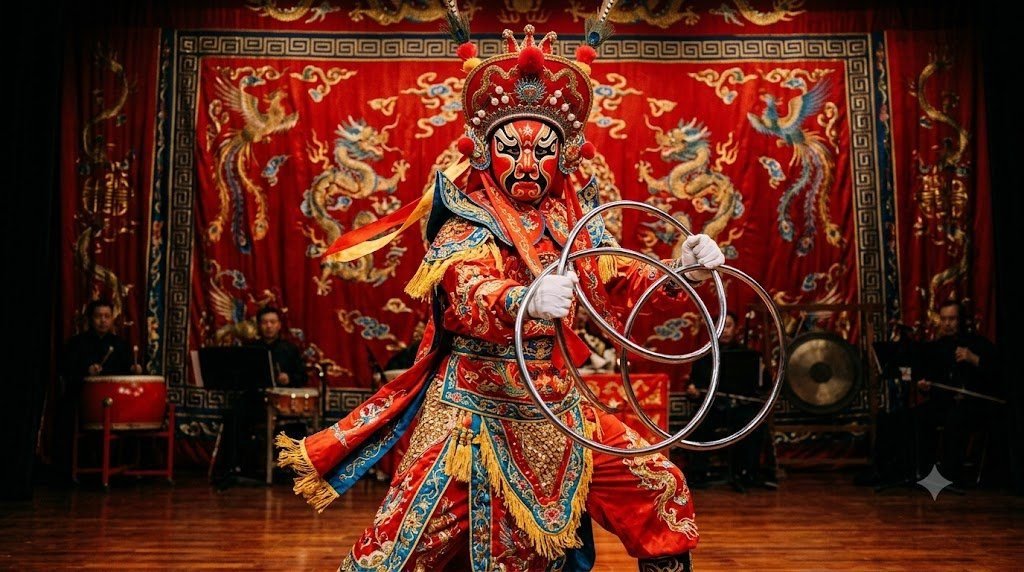
The Classical Heritage: Imperial Patronage and Operatic Conjuring
Across East Asia, the traditions of illusion and stage magic evolved along an aesthetic trajectory profoundly distinct from Western conjuring. While European magic developed primarily as an intellectual contest of scientific trickery or parlour deception, Chinese, Japanese, and Korean illusion arts were deeply embedded within classical operatic drama, martial arts choreography, acrobatics, and sacred temple storytelling. Throughout the Han, Tang, and Qing dynasties, court illusionists—known as ‘Za-ji’ (miscellaneous arts) performers—were revered members of imperial cultural troupes, performing before emperors in the Forbidden City.
The Asian magical aesthetic prioritizes visual elegance, seamless physical economy, and profound spiritual metaphor. Rather than presenting magic as a clever puzzle to be solved, classical Asian conjurers presented illusions as natural extensions of internal mastery, chi balance, and theatrical beauty. In this extensive master treatise, we explore three of the most revered and technically stunning traditions in Asian conjuring: the secretive art of Sichuan Opera’s Bian Lian (Face-Changing), the astonishing physics of the Chinese Water Bowl production, and the timeless mathematical elegance of the Ancient Chinese Linking Rings.
🎭 Cultural Landmark: The Secrecy of Bian Lian
Under Chinese cultural heritage regulations, the secret mechanics of Bian Lian (Face-Changing) are classified as a State Secret of the People’s Republic of China, protected by law as an intangible national cultural treasure. Revealing the method outside accredited operatic master-disciple lineages is strictly forbidden.
Bian Lian: The High-Speed Miracle of Sichuan Face-Changing
Among all the performing arts of Asia, none is more visually explosive, breathtaking, and fiercely guarded than ‘Bian Lian’ (Face-Changing), an integral component of traditional Sichuan Opera dating back over three centuries to the Qing Dynasty. In an authentic Bian Lian performance, a warrior-actor dressed in an opulent, traditional silk operatic costume with flowing sleeves, heavy armor, and a towering crested helmet steps onto the stage. With lightning-fast, martial-arts choreography, the performer turns his head, flourishes a silk fan, or sweeps an arm across his face—and in a fraction of a second (faster than the human eye can blink), the brightly painted mask covering his face visibly and completely transforms into a radically different color and expression!
The actor may cycle through ten, fifteen, or even twenty distinct masks in a single four-minute performance: shifting from a heroic red mask (symbolizing courage and loyalty) to a demonic green mask (wrath), a ghostly white mask (treachery), a golden mask (divinity), and finally revealing the performer’s bare human face, before instantly snapping a final mask back over his face! The speed of each transformation is measured in milliseconds, leaving audiences stunned by the apparent violation of physical matter.
The Classical Mechanisms of Face-Changing
While the detailed individual choreography of contemporary Bian Lian remains proprietary to master operatic families, theatrical scholars identify four traditional methodologies used across operatic history:
- Pulling Masks (Che Lian): The dominant technique in modern stage performance. The masks are painted on paper-thin, specially treated silk, layered sequentially over the performer’s face. Each mask is connected to a high-tensile, micro-fine silk cord concealed within the folds of the costume, running through low-friction eyelets to trigger points located in the sleeves, belt, or wrists. Through explosive martial-arts gestures, the performer jerks a trigger, instantly ripping the top mask off and snapping it into a concealed, spring-tensioned storage pocket in the costume in under 0.02 seconds.
- Wiping Masks (Mo Lian): The performer conceals colored cosmetic greasepaint (traditionally tinted with mineral pigments) in their sideburns, forehead band, or the palm of their hand. With a rapid wipe across the face, the actor blends the pigment across their features, transforming their color from gold to black or red.
- Blowing Powder (Chui Lian): The performer places a tiny bowl or paper tube containing colored cosmetic powder (such as silver, gold, or charcoal) on the floor or on a prop. During an acrobatic somersault or dramatic fall, the performer exhales sharply, blowing the powder directly onto their sweated face, instantly altering their complexion.
- Breathing Change (Qi Lian): The most esoteric internal martial discipline, where masters utilized profound qigong respiratory control to slow heartbeat and shift facial blood flow, visibly blanching their complexion from flushed red to pale white.
| Asian Conjuring Tradition | Origin & Era | Defining Apparatus | Core Physical / Sleight Mechanism | Theatrical / Cultural Purpose |
|---|---|---|---|---|
| Bian Lian (Face-Changing) | Sichuan Opera (Qing Dynasty) | Layered micro-silk masks & silk pull cords | Martial gesture trigger & rapid pocket retraction | Expresses sudden psychological shifts of operatic heroes |
| The Water Bowl Production | Imperial Court (Ming/Qing) | Massive porcelain bowl filled with water/goldfish | Body loading, deep harness pouch, and core counter-balance | Demonstrates supreme physical strength and generosity |
| The Chinese Linking Rings | Ancient China / Global | Set of 8 solid steel or brass rings | Single precision-ground key ring with narrow gate | Symbolizes cosmic unity, balance, and infinity |
| Wazuma (Japanese Magic) | Edo Period Japan (1603–1867) | The Butterfly Trick (Kocho no Mai) | Fine silk fans & thread-guided rice paper butterflies | Poetic Zen meditation on love, nature, and impermanence |
| Mask-Masking (Korean Talchum) | Joseon Dynasty Korea | Carved alder wood satirical masks | Rapid head turns and shoulder shrugs | Social satire challenging aristocratic corruption |
The Chinese Water Bowl Production: Triumph Over Gravity and Fluid
In classical Chinese conjuring, no illusion commanded greater awe than the production of the massive Water Bowl, famously performed in the West by Chinese master Ching Ling Foo (Chee Ling Qua, 1854–1922). Standing in the center of an empty stage, wearing only a traditional silk Chinese robe, the performer displayed a large, empty decorative cotton cloth, shaking it out to prove the absence of concealed objects.
Draping the cloth over his outstretched arms for a single second, the performer suddenly knelt to the stage floor and whipped the cloth away. Resting on the floor was a colossal, heavy porcelain bowl filled to the brim with gallons of water, with live goldfish swimming inside, weighing over eighty to one hundred pounds! In his signature climax, Foo reached back under the cloth and produced a second giant bowl, followed by a live human child!
The Water Bowl production is a monumental feat of physical conditioning and anatomical leverage. The giant bowl—sealed across its top rim by a thick, waterproof sheet of vulcanized rubber held in place by elastic tension—was suspended from a heavy canvas and leather harness worn under the performer’s robe, nestled between his thighs. Foo walked with an imperceptible, rolling martial-arts gait that counter-balanced the forty-kilogram weight. In kneeling, his hands engaged a quick-release catch that dropped the bowl to the stage floor, while his fingers peeled away the rubber cover under the concealment of the cloth. It was a triumph of extreme physical athletics disguised as effortless sorcery.
The Ancient Chinese Linking Rings: The Harmony of Steel
Known in China as ‘Jiulianhuan’ (Nine Interlinked Rings) and dating back over a thousand years to the Song Dynasty, the Linking Rings represents the absolute pinnacle of classical geometric conjuring. The performer introduces a set of eight solid, heavy steel or brass rings, allowing spectators to bang them together, inspect their solid joints, and verify that they are completely solid, unbroken loops.
Yet before the audience’s eyes, the performer effortlessly melts the rings together: rubbing two rings until they link like chains, linking three, linking four, and forming intricate, geometric sculptural patterns: globes, four-leaf clovers, blooming flowers, and hanging chains. Just as effortlessly, the rings melt apart, falling to the floor with resonant metallic clangs.
The secret of the rings lies in the exquisite combination of a single precision-ground ‘Key Ring’—a ring featuring a narrow opening barely wide enough to permit another ring to slide through—paired with un-gimmicked solid rings and permanently interlinked chains of two and three. The art of the routine lies entirely in finger manipulation: master ring technicians keep the tiny gap in the key ring concealed under their thumb or fingers, executing fluid, continuous spinning motions that visually mask the passage of the steel. The routine is not merely a trick; it is an abstract, Zen-like meditation on continuous form and dimensional transition.
Wazuma: The Butterfly Trick and the Zen of Japanese Magic
In Japan, the classical tradition of illusion—termed ‘Wazuma’—reached its poetic zenith during the Edo Period (1603–1867). Unlike Western magic, which often carried aggressive overtones of conquest or technological domination, Wazuma was deeply informed by Shinto animism and Buddhist mindfulness. Its crowning masterpiece remains ‘Kocho no Mai’ (The Flying Butterflies), popularized in the West by Japanese masters like Shigeru Enomoto and modern virtuoso Juliana Chen.
The performer tears two small pieces of white rice paper into the delicate shapes of male and female butterflies. Placing them upon a silk folding fan, the performer begins gently waving the fan. Slowly, the paper butterflies flutter into the air. With exquisite, rhythmic movements of the fan, the magician directs the butterflies to dance around their body, land gently on the rim of the fan, fly out over the audience, and sip nectar from a fresh flower, before multiplying into a blizzard of hundreds of fluttering white butterflies. Utilizing micro-fine, invisible silk fibers guided by air currents, the trick transforms paper into living poetry, embodying the Zen aesthetic of Mono no Aware—the poignant beauty of the ephemeral.
Conclusion: The Enduring Soul of Asian Illusion
The classical illusion traditions of Asia remind us that magic is not merely an intellectual puzzle or a demonstration of deceit; it is a sacred theatrical discipline that reflects the deepest philosophical values of the cultures that birthed it. Through the breathtaking velocity of Bian Lian, the titanic physical mastery of the Water Bowl, and the serene poetry of the paper butterflies, Asian conjuring achieves something truly transcendent: an art form that elevates the human spirit and bridges the finite world of human flesh with the infinite mystery of the cosmos.
The Tenyo Phenomenon: Japan’s Micro-Plastic Engineering Revolution
In the mid-twentieth century, the traditional Japanese heritage of Wazuma underwent a radical transformation that established Japan as the undisputed global capital of micro-mechanical magic engineering: the rise of the Tenyo Corporation. Founded in Tokyo by Akira Sugawara in 1960 and fueled by the mechanical genius of inventor Shigeru Sugawara and Toru Suzuki, Tenyo revolutionized the global conjuring industry by manufacturing precision plastic pocket tricks that operated with the mechanical tolerances of Swiss wristwatches.
Tenyo designers rejected cheap, flimsy novelty toys; instead, they engineered intricate internal mechanisms—hidden differential gears, magnetic polarities, polarized optical filters, and micro-cantilevers—molded from high-impact ABS plastics. In legendary releases like ‘The Zingg Box’, ‘Crystal Cleaver’, and ‘Miracle Dice’, Tenyo allowed an ordinary child or amateur to perform miracles where solid steel swords visibly penetrated solid plastic rings inside transparent boxes without human sleight of hand. Respected international masters, including David Copperfield and Penn & Teller, collect Tenyo tricks with fanatical devotion, celebrating them as masterpieces of applied industrial origami.
Ching Ling Foo vs. Chung Ling Soo: The Epic London Rivalry of 1905
No chapter in the history of Asian illusionism is more dramatic than the fierce public feud that erupted in London in 1905 between authentic Chinese master Ching Ling Foo (Chee Ling Qua) and his audacious American copycat, Chung Ling Soo (William Ellsworth Robinson). Foo was headlining at the London Empire Theatre, billing himself as the genuine court conjurer to the Empress of China, and publicly offered £1,000 to anyone who could duplicate his incredible Water Bowl production.
Chung Ling Soo—an American from Brooklyn who had shaved his head into a queue, donned Manchu silk robes, and adopted a fictional Chinese persona—accepted the challenge, performing at the rival Hippodrome. Soo not only duplicated Foo’s Water Bowl production; his Western theatrical training allowed him to pace the show with superior dynamic rhythm, comedy, and pacing. When the two performers engaged in a public press war in the London newspapers, the English public embraced Chung Ling Soo with fervor, completely oblivious to the fact that their favorite Chinese magician spoke with a thick Brooklyn accent behind closed doors. The rivalry remains a fascinating historical case study in cultural translation, orientalism, and stagecraft.