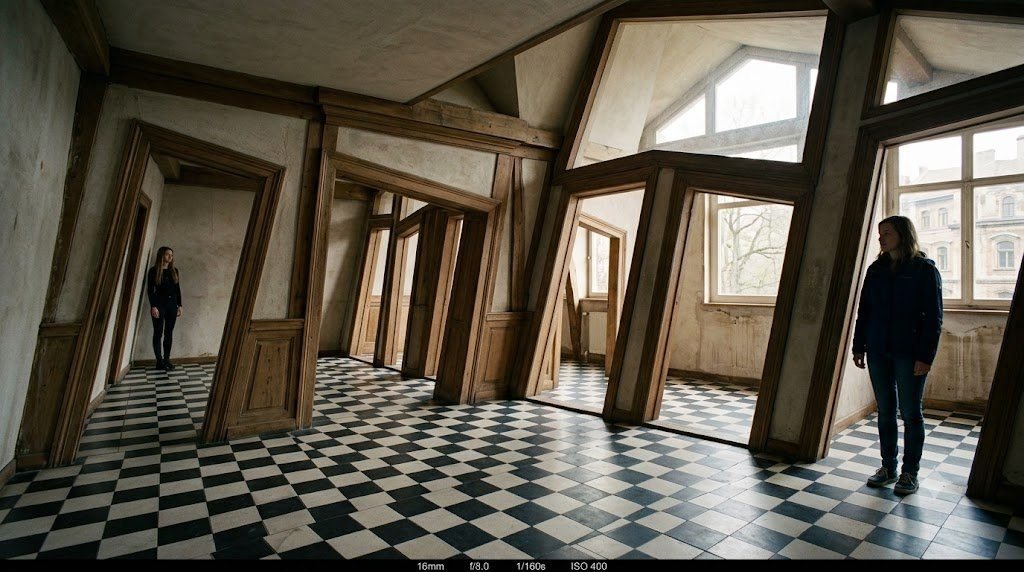
The Renaissance of Deception: When Geometry Warps Space
Since the mathematical codification of linear perspective during the Italian Renaissance by Filippo Brunelleschi and Leon Battista Alberti, artists and architects have recognized that human vision is fundamentally projective. When light rays travel from a three-dimensional scene through the nodal point of the crystalline lens onto the planar, two-dimensional curved sheet of the retina, an infinite number of distinct physical three-dimensional configurations can produce the exact same two-dimensional retinal projection. This geometric ambiguity is termed the ‘inverse optics problem’.
For more than five centuries, master artisans, stage designers, and illusionists have weaponized this inverse optics ambiguity to craft astonishing architectural manipulations and anamorphic illusions. Anamorphosis—derived from the Greek words ‘ana’ (back, again) and ‘morphe’ (form)—refers to an image that appears distorted, indecipherable, and warped when viewed from conventional vantage points, but resolves into a stunning, photo-realistic, three-dimensional scene when observed from a single, highly specific mathematical focal coordinate in space, or through a curved specular mirror.
From the sublime Renaissance ceiling frescoes of Andrea Pozzo that dissolve stone cathedrals into the infinite heavens, to the mind-bending Ames Room designed by American ophthalmologist Adelbert Ames Jr., to modern street painters like Julian Beever and Kurt Wenner who turn flat asphalt into bottomless subterranean chasms, anamorphosis represents the ultimate convergence of Euclidean geometry, architectural engineering, and perceptual psychology. In this extensive master treatise, we deconstruct the projective mathematics, perceptual cues, and neurological mechanisms of forced perspective illusions.
📐 Mathematical Essence: Projective Collineation
Anamorphic projection relies on projective collineation—a mathematical transformation that maps lines to lines from one plane to another. By projecting an image through a virtual pinhole onto an oblique ground plane, the coordinates stretch exponentially along the axis of sight, creating an illusion that resolves only when the viewer’s eye occupies the exact virtual pinhole.
Hans Holbein and ‘The Ambassadors’: The Skull of Memento Mori
The most celebrated classical masterpiece of anamorphic art is Hans Holbein the Younger’s double portrait ‘The Ambassadors’ (1533), currently housed in the National Gallery in London. The painting depicts two wealthy, erudite French diplomats—Jean de Dinteville and Georges de Selve—surrounded by a meticulously rendered collection of mathematical, astronomical, and musical instruments, symbolizing the pinnacle of Renaissance humanism, imperial statecraft, and worldly achievement.
Yet hovering across the bottom center of the canvas, resting between the diplomats’ feet, lies a bizarre, pale, diagonal smear that looks completely foreign to the realism of the rest of the painting. To contemporary visitors approaching the canvas head-on, the smear resembles an elongated cuttlefish bone or an abstract gray streak. However, when the viewer walks to the far right edge of the painting, places their right eye near the level of the canvas, and looks back across the surface at an acute glancing angle of approximately twenty degrees, the distorted smear undergoes a dramatic, instantaneous projective foreshortening. The smear coalesces into a chilling, anatomically perfect human skull.
Holbein’s anamorphic skull was not merely a display of virtuosic geometric mastery; it was a profound philosophical and theological statement. In the visual language of the Renaissance, the skull is a ‘memento mori’—a reminder of the inevitability of mortality and the vanity of earthly wealth. By forcing the viewer to alter their physical posture and leave behind the flattering frontal perspective of worldly luxury in order to see the skull, Holbein demonstrated that ultimate truth requires a radical shift in perspective, warning the viewer that beneath all diplomatic splendor lies decay and death.
Catoptric Anamorphosis: The Curved Cylindrical Mirror
Beyond oblique planar perspective, the sixteenth and seventeenth centuries saw the development of ‘catoptric anamorphosis’—illusions engineered specifically to be decrypted using curved specular reflective surfaces, most commonly polished cylindrical, conical, or pyramidal mirrors. Pioneered by mathematicians such as Jean-François Niceron in his seminal 1638 work ‘La Perspective Curieuse’, catoptric anamorphosis involves unrolling a circular image onto a flat plane using coordinate transformations based on cylindrical reflection laws (angle of incidence equals angle of reflection on curved surfaces).
When viewed on the flat table, a catoptric painting appears as a chaotic, swirling vortex of deformed brushstrokes, utterly devoid of recognizable form. However, the moment a polished chrome or silver cylinder is placed precisely at the center of the disc, the curved surface of the mirror reverses the geometric distortion, reassembling the chaotic rays into an exquisite miniature portrait of a king, a sacred saint, or a scandalous satirical caricature. Catoptric art functioned as a sophisticated form of visual steganography, allowing persecuted religious dissidents and political revolutionaries to transmit seditious or forbidden messages concealed in plain sight.
| Era / Movement | Masterpiece / Apparatus | Pioneer / Architect | Core Optical Mechanism | Intended Perceptual Effect |
|---|---|---|---|---|
| Northern Renaissance (1533) | The Ambassadors (Skull) | Hans Holbein the Younger | Oblique linear anamorphosis | Hidden memento mori visible only at an acute 20° angle |
| Baroque Catoptric (1638) | La Perspective Curieuse | Jean-François Niceron | Cylindrical specular mirror mapping | Chaotic radial swirl reassembles into regal portrait |
| Baroque Trompe-l’œil (1694) | Sant’Ignazio Ceiling Fresco | Andrea Pozzo | Spherical projective geometry on barrel vault | Flat ceiling appears as a soaring 100-foot dome into heaven |
| Baroque Forced Perspective (1635) | Palazzo Spada Colonne Gallery | Francesco Borromini | Diminishing arch heights & converging floor tiles | 8-meter corridor appears as a massive 37-meter grand hall |
| Visual Psychology (1946) | The Ames Room | Adelbert Ames Jr. | Trapezoidal room geometry with monocular viewing | Humans physically grow and shrink as they walk across the room |
| Cinematic In-Camera FX (2001) | Lord of the Rings Hobbit Sets | Peter Jackson & Grant Major | Split-scale furniture & dual-axis dolly tracking | Actors appear half the height of wizards without CGI |
Trompe-l’œil and Andrea Pozzo’s Soaring Baroque Domes
Trompe-l’œil—literally translated from French as ‘to deceive the eye’—is an artistic technique that uses realistic imagery to create the optical illusion that the depicted objects exist in three dimensions. While easel painters applied trompe-l’œil to render flies crawling on fruit or letters tucked into ribbons, the ultimate expression of the art occurred within Baroque sacred architecture, spearheaded by the Italian Jesuit painter and architect Andrea Pozzo.
In the Church of Sant’Ignazio in Rome, the original architectural budget ran out before a stone dome could be constructed over the crossing of the nave. In 1685, the Jesuits commissioned Pozzo to paint an illusory dome on a flat, horizontal canvas measuring seventeen meters in diameter, stretched across the ceiling. Pozzo executed a masterclass in perspective mathematics: he calculated the sightlines from a single yellow marble medallion embedded in the central nave floor. From this exact spot, the flat canvas dissolves completely, replaced by a soaring, coffered hemispherical dome, complete with architectural ribs, lantern windows, and realistic sunbeams that match the church’s actual window orientations.
Pozzo formalized this methodology in his landmark 1693 treatise ‘Perspectiva Pictorum et Architectorum’ (Perspective in Architecture and Painting). To transfer a three-dimensional design onto a curved barrel vault ceiling, Pozzo placed a point light source (such as an oil lamp) at the intended viewing coordinate in a scale model of the cathedral. By running physical strings from the lamp to points on a rectilinear grid, he projected the precise geometric distortion required onto the curved surfaces, inventing the mathematical foundation for modern computer-generated texture mapping and 3D architectural projection.
Francesco Borromini’s Palazzo Spada: Architectural Forced Perspective
While Pozzo painted illusions on flat ceilings, the legendary Roman architect Francesco Borromini achieved the equivalent illusion in three physical dimensions at the Palazzo Spada in Rome (constructed in 1652–1653). Cardinal Bernardino Spada wished to transform a cramped, eight-meter exterior courtyard into an imposing, regal processional gallery leading to an outdoor garden. Constrained by neighboring property walls, Spada had no physical room to build an expansive hallway.
Working alongside mathematician Father Giovanni Maria da Bitonto, Borromini constructed a gallery that appears to be an imposing, thirty-seven-meter-long classical colonnade terminating in a life-sized heroic marble statue of Mars standing two meters tall. In physical reality, the gallery is a mere 8.58 meters in length. Borromini engineered this forced perspective by simultaneously altering four architectural vectors:
- Converging Walls: The lateral walls converge dramatically, tapering from a width of 3.2 meters at the entrance down to only 1.2 meters at the rear exit.
- Descending Barrel Vault: The vaulted ceiling slopes steeply downward from 5.8 meters high at the entrance to only 2.4 meters at the terminus.
- Rising Floor Gradient: The floor slopes upward toward the rear, creating an artificial rising horizon line.
- Diminishing Columns: The rows of classical columns shrink systematically in height and intercolumniation spacing as they approach the back.
When an observer stands at the entrance, the visual system automatically assumes that the colonnade obeys orthogonal, parallel Euclidean architecture. The brain decodes the converging lines as indicators of vast distance rather than converging walls. When an adult human walks down the Spada gallery to the terminus, a surreal cognitive shock occurs: the person towers over the rear arches, revealing that the heroic statue of Mars is in fact a tiny sixty-centimeter garden figurine!
🏛️ Cognitive Conflict: Why the Spada Illusion Trumps Rationality
Even after an observer watches a human walk down the Spada corridor and witnesses the scale distortion firsthand, the gallery continues to appear thirty-seven meters long when the observer returns to the entrance. Intellectual knowledge of the trick cannot override the visual cortex’s deep perspective processing.
The Ames Room: Where Rectilinear Assumptions Demolish Biology
In 1946, American ophthalmologist Adelbert Ames Jr. constructed what would become the most famous sensory laboratory apparatus in history: the Ames Room. When viewed with one eye through a small peephole stationed in the front wall, the room appears to be a perfectly normal, rectangular, cube-shaped room with parallel walls, a level floor, and rectangular windows on the back wall. However, when two people of identical height stand in opposite back corners, the person on the left appears as an infinitesimal dwarf, while the person on the right appears as a towering, mythical giant. When the individuals walk across the room and trade places, they appear to visibly grow and shrink before the observer’s eyes!
The true physical geometry of the Ames Room is entirely trapezoidal and asymmetric. The floor is an inclined polygon; the ceiling rises at a steep angle; the back wall recedes at a severe angle away from the viewer. The left-hand corner is physically twice as far from the peephole as the right-hand corner. However, the angles of the floor, walls, windows, and checkerboard floor tiles are distorted with exquisite mathematical precision such that their perspective lines converge into the exact same retinal projection that a normal rectangular room would cast onto the eye.
Why does the human brain choose to perceive impossible humans that grow and shrink rather than a distorted trapezoidal room? The answer lies in the Bayesian likelihood principle. In our evolutionary lifetime within carpentered human civilizations, we have encountered hundreds of thousands of rectangular rooms, and exactly zero humans who can change their physical biological stature by walking five steps. Given an ambiguous sensory projection, the brain’s predictive coding system assumes the room is rectangular with near-infinite prior probability. Consequently, the brain forces the perceived height of the human bodies to absorb the mathematical discrepancy, demonstrating that perceptual reality is constructed through a hierarchy of deeply ingrained evolutionary assumptions.
Forced Perspective in Modern Cinema: The Lord of the Rings
The principles of Borromini and Ames were immortalized in modern cinema by director Peter Jackson and cinematographer Andrew Lesnie in the filming of ‘The Lord of the Rings’ trilogy. To depict normal-sized adult actors as diminutive hobbits standing three-and-a-half feet tall alongside towering wizards six feet tall without relying on costly and disjointed computer-generated imagery, the production team utilized physical forced perspective on practical sets.
In scenes where Frodo Baggins (Elijah Wood) sits at a dining table opposite Gandalf (Ian McKellen), Wood was physically seated several feet farther back from the camera than McKellen. The table was built as a split-level trapezoid: the side near Wood featured oversized plates, oversized mugs, and an oversized chair, while the side near McKellen featured miniature cutlery and a tiny chair. To the monocular camera lens, the two halves of the table aligned into a single continuous plane, making Frodo appear half Gandalf’s size.
To overcome the classic limitation that forced perspective breaks down the moment the camera moves, the camera team invented motion-control forced-perspective rigs. As the camera dollied laterally, the actor stationed farther away was mounted on a synchronized motorized platform that slid along an inverse vector, preserving the exact visual alignment throughout dynamic camera movements—a monumental marriage of Victorian theatrical trickery and modern robotic engineering.
Modern 3D Pavement Art: Transforming Flat Asphalt into Infinite Voids
In the twenty-first century, the principles of Andrea Pozzo and Hans Holbein were reborn on the public streets through the work of anamorphic pavement artists such as Kurt Wenner, Julian Beever, and Edgar Müller. Drawing with soft pastels on city sidewalks, these artists create murals that appear as incomprehensibly stretched, smeared ribbons of color from all directions, except when viewed through a camera lens stationed at a precise height and angle on a tripod.
From this dedicated vantage point, the flat asphalt appears to crack open, revealing gaping subterranean chasms, cascading crystal waterfalls, subterranean dungeons, and soaring spires. The mathematical elongation required for pavement art is extreme: an object that appears circular from the camera’s perspective must be drawn as an ellipse stretched ten to twenty times its width along the horizontal plane. Because the viewer’s eye is stationed so close to the ground, the depth compression algorithm requires millimeter accuracy. By incorporating synthetic drop-shadows and photographic perspective highlights, the artist provides artificial depth cues that completely override the tactile reality of the flat ground, inviting pedestrians to step across what appears to be an abyss.
Conclusion: The Geometry of Visual Delight
Anamorphic art and forced perspective architecture provide the definitive empirical demonstration that visual perception is an act of translation rather than replication. Our eyes register a flat, two-dimensional light field, and our cerebral cortex solves an inverse mathematical equation to reconstruct a plausible three-dimensional environment. When artists like Holbein, architects like Borromini, and scientists like Ames master the underlying projective geometry, they expose the seams of this biological simulation, transforming visual perception into an arena of profound wonder, philosophical contemplation, and intellectual delight.