The Sacred Origins: Automata, Priesthoods, and Pneumatic Deception
The history of stage magic is inextricably entwined with humanity’s quest to manipulate the sacred, the mechanical, and the theatrical. Thousands of years before conjuring was categorized as popular entertainment, the foundational techniques of illusion—hidden levers, acoustic tubes, hydraulic valves, and forced optical angles—were the exclusive preserve of temple priesthoods in ancient Mesopotamia, Pharaonic Egypt, and Hellenistic Greece. To the devout worshipper entering the dimly lit sanctuary, a statue that wept tears, a temple door that swung open autonomously upon the lighting of an altar fire, or a bronze oracle that spoke with a booming subterranean voice was not perceived as theatrical prestidigitation; it was experienced as the direct, terrifying manifestation of divine will.
In the first century CE, the Greco-Egyptian mathematician and engineer Hero of Alexandria authored his legendary treatises ‘Pneumatica’ and ‘Automata’. Within these technical manuscripts, Hero documented the secret engineering behind temple wonders: hollow copper pipes concealed within stone masonry that siphoned heated air to expand water reservoirs, counterweights hidden behind walls that turned massive temple gates, and mechanical singing birds operated by pressurized steam. These ingenious physical contraptions established the fundamental paradigm of stage illusion: the rigorous application of natural philosophy, applied mechanics, and secretive engineering to produce an effect that appeared to defy the known laws of nature.
As classical civilizations waned, the art of conjuring retreated into the raucous medieval marketplace. Wandering jugglers, mountebanks, and street prestidigitators performed cups-and-balls routines and knife tricks on makeshift wooden trestles, constantly risking accusations of demonic witchcraft or heresy. In 1584, Reginald Scot published ‘The Discoverie of Witchcraft’—not to teach magic, but to save innocent street performers from being burned at the stake by demonstrating that their miracles were accomplished through mundane manual dexterity, false-bottomed vessels, and hidden assistants. It was not until the enlightenment of the mid-nineteenth century that conjuring threw off its disreputable itinerant cloak and ascended into regal urban theaters, transformed into an aristocratic art form by a French clockmaker named Jean-Eugène Robert-Houdin.
📜 Historical Landmark: The Westcar Papyrus (circa 1700 BCE)
The earliest written record of a conjuring performance appears in the ancient Egyptian Westcar Papyrus, which details a performance by the magician Dedi of Djed-Sneferu before Pharaoh Khufu. Dedi famously performed the decapitation and seamless reattachment of a goose, a pelican, and an ox, establishing the archetype of restorative illusion.
Jean-Eugène Robert-Houdin: The Father of Modern Magic
Widely revered as the father of modern conjuring, Jean-Eugène Robert-Houdin (1805–1871) fundamentally revolutionized the aesthetic, philosophy, and presentation of illusion. Prior to Robert-Houdin, performers such as Isaac Fawkes and Bartolomeo Bosco dressed in flamboyant astrological robes adorned with mystical cabalistic symbols, surrounding themselves with stuffed owls, skulls, smoking braziers, and heavily draped velvet tables concealing trapdoors. Robert-Houdin recognized that this mystical charade was obsolete in an age of scientific industrialization.
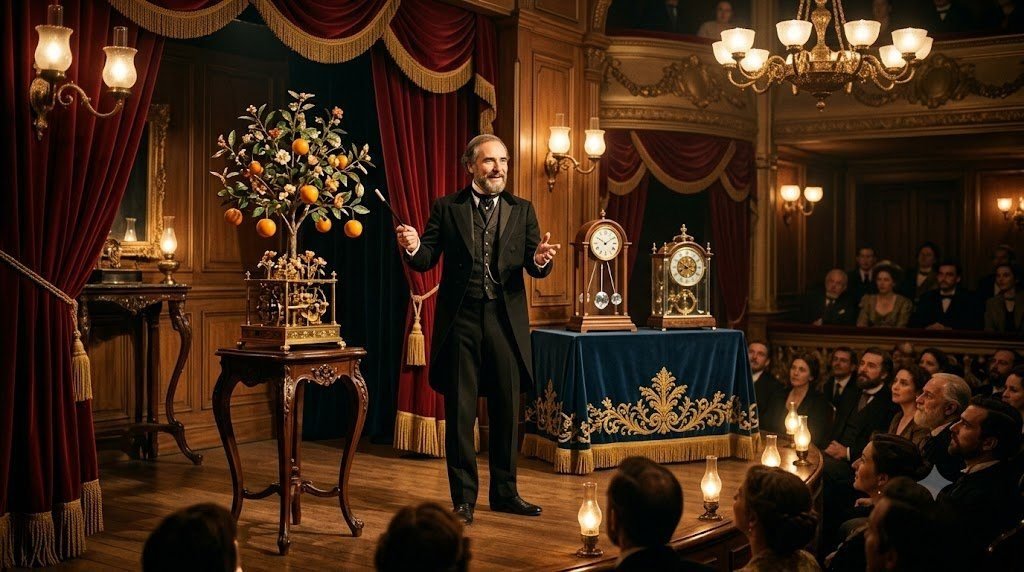
In 1845, Robert-Houdin opened his intimate ‘Soirées Fantastiques’ at the Palais-Royal in Paris. He shocked European high society by striding onto the stage dressed not as a medieval necromancer, but as an immaculate Parisian gentleman wearing an elegant evening tailcoat. His stage set was bright, minimalist, and decorated like an aristocratic Louis XV drawing room, featuring transparent glass tables and slender gilded furniture that visually eliminated any suspicion of secret bulk or hidden assistants. By presenting magic as intellectual diversion and scientific wonder rather than supernatural sorcery, he elevated the conjurer to the status of an educated savant.
Leveraging his peerless genius as an horologist and precision mechanician, Robert-Houdin constructed extraordinary electromechanical automata that stunned the world. His ‘Mysterious Orange Tree’ allowed an audience member to write their initials on a borrowed handkerchief, which was vanished into a pistol; Robert-Houdin then caused an artificial orange tree to blossom with live flowers, sprout genuine fruit which was distributed to the audience, and finally produce two mechanical butterflies that flew up from the branches holding the spectator’s folded, restored handkerchief. Similarly, his ‘Suspension Éthéréenne’ (Ether Suspension)—which debuted in 1847 amidst the public sensation surrounding the medical discovery of ether—saw his young son suspended horizontally in mid-air, resting solely upon the tip of an upright wooden walking cane, pioneering the entire genre of stage levitation.
The Algerian Diplomatic Mission of 1856: Magic as Imperial Statecraft
Robert-Houdin’s mastery was so extraordinary that in 1856, the French government under Emperor Napoleon III summoned him out of retirement for an unprecedented diplomatic mission to French Algeria. Arab religious leaders known as Marabouts were inciting tribal rebellion against French colonial authorities by demonstrating apparent supernatural miracles, such as handling live scorpions and fire. The French military command tasked Robert-Houdin with proving that French ‘secular magic’ was vastly superior to the Marabouts’ religious wonders.
Before an assembly of influential tribal chieftains, Robert-Houdin performed his ‘Light and Heavy Chest’—a small wooden box with an iron bottom plate resting over a powerful electromagnet concealed beneath the stage flooring. Robert-Houdin announced that he could drain a man’s physical strength at will. He invited a fierce, powerful Arab warrior to lift the box; the warrior hoisted it effortlessly. Robert-Houdin then made a magical gesture, signaling his offstage assistant to complete an electrical circuit. The electromagnet engaged with colossal magnetic force. The warrior strained, sweated, and pulled until his muscles seized, but could not lift the box a millimeter from the floor. Combined with a trick where Robert-Houdin appeared to catch an assassin’s fired lead bullet in an apple, the psychological pacification was complete; the Marabouts’ authority dissolved, averting armed rebellion without bloodshed.
| Illusionist / Master | Era & Nationality | Defining Illusion / Innovation | Staging Innovation | Enduring Historical Impact |
|---|---|---|---|---|
| Hero of Alexandria | 1st Century CE (Greco-Egyptian) | Pneumatic temple automata & singing birds | Concealed hydraulic pipes & counterweights | First documented engineering treatise on applied illusion |
| Jean-Eugène Robert-Houdin | 1805–1871 (French) | The Orange Tree, Ether Suspension, Heavy Chest | Evening tailcoat dress & minimalist glass furniture | Codified magic as high intellectual theater; father of modern conjuring |
| Alexander Herrmann | 1844–1896 (French/American) | Herrmann the Great grand illusions, sleights | Satanic goatee, theatrical flair, grandiose scale | Established the archetype of the dapper, mysterious stage magician |
| Harry Kellar | 1849–1922 (American) | The Levitation of Princess Karnac | Complex mechanical stage hoists & goose-neck wire | First American-born international illusion superstar |
| John Nevil Maskelyne | 1839–1917 (British) | Egyptian Hall, Box Escapes, Automaton ‘Psycho’ | Permanent magical theater venue & anti-spiritualist exposes | Pioneered mechanical stagecraft and protected artistic copyright |
| Georges Méliès | 1861–1938 (French) | Cinematographic special effects, Stop-Trick | Director of Robert-Houdin Theatre; Father of Sci-Fi Film | Merged stage conjuring with motion pictures to invent cinema editing |
| Chung Ling Soo (W. Robinson) | 1861–1918 (American/British) | Exotic Chinese persona & Defying the Bullets | Total immersion in character, never speaking English on stage | Tragic 1918 live bullet accident on London stage |
The Herrmann Dynasty and American Theatrical Extravaganza
While Robert-Houdin perfected salon refinement, the late nineteenth century witnessed the explosion of grand touring theatrical spectacles, dominated by the Herrmann dynasty. Alexander Herrmann, known globally as ‘Herrmann the Great’ (1844–1896), embodied the quintessential archetypal magician: thin, aristocratic, sporting an impeccably waxed moustache and pointed goatee, radiating an aura of playful, demonic brilliance. Alexander, along with his elder brother Compars Herrmann and his formidable wife Adelaide Herrmann, toured international opera houses with massive entourages, performing on an opulent, grand scale.
Herrmann bridged the gap between fine sleight-of-hand card manipulation and monumental stage illusions. He could vanish live canaries from the palm of his hand with breathtaking sleight of hand, then transition seamlessly to firing loaded artillery cannons at female assistants who vanished from mid-air to reappear locked inside steel cages in the theater balcony. Following Alexander’s sudden death in 1896, Adelaide Herrmann took over the massive show as ‘The Queen of Magic’, becoming one of the most prominent female illusionists in history, performing the perilous Bullet Catch across world stages for more than three decades.
Harry Kellar and Howard Thurston: The Wonder Shows of the World
In the United States, Alexander Herrmann’s chief rival was Harry Kellar (1849–1922), the undisputed Dean of American Magicians. Kellar lacked Herrmann’s natural flamboyance and sleight-of-hand agility; instead, he was a master craftsman, a relentless perfectionist, and a shrewd theatrical technician who understood the immense power of grandiose, flawless stage illusions. Kellar’s crowning achievement was ‘The Levitation of Princess Karnac’, an illusion that drove audiences and rival magicians into paroxysms of bewilderment.
In Princess Karnac, a female assistant reclined asleep on an ornate couch. Kellar stepped forward, made hypnotic passes, and the assistant slowly rose several feet into the air, floating horizontally without visible cords, wires, or supports. Kellar then took a solid steel hoop, walked completely around the floating woman, and passed the hoop over her entire body from head to toe, definitively ‘proving’ the absence of mechanical physical connections.
The secret of the illusion was a masterwork of structural engineering conceived by British illusionist John Nevil Maskelyne, which Kellar audaciously acquired. The assistant was supported by an extraordinarily rigid, S-shaped curved steel crank arm (known in magic engineering as a ‘goose-neck’ bar) that projected horizontally through a slit in the dark velvet backdrop. The counterbalanced goose-neck bar was mounted on a silent hydraulic piston located backstage. When Kellar passed the solid hoop over the assistant, he manipulated the hoop through the bends of the S-curve with fluid choreography, creating the flawless cognitive illusion that the hoop had traversed an unobstructed space. This mechanical breakthrough laid the blueprint for every modern stage levitation performed today.
Upon Kellar’s retirement in 1908, he passed his mantle and show to Howard Thurston (1869–1936). Thurston transformed the illusion show into a colossal industrial circus: ‘Thurston’s Wonder Show of the Universe’. Touring with eight railroad baggage cars carrying dozens of assistants, animal menageries, and massive mechanical set pieces, Thurston vanished automobiles, caused lion cages to disappear in mid-air, and popularized card spinning across giant theater halls, proving that magic was among the most profitable entertainment franchises in American history.
🎭 The Tragic Tale of Chung Ling Soo (1918)
William Ellsworth Robinson, an American illusionist, lived for eighteen years entirely in character as the mythical Chinese wizard ‘Chung Ling Soo’, never speaking English in public. On March 23, 1918, at London’s Wood Green Empire, his gun apparatus failed during his signature trick ‘Defying the Bullets’. The real bullet fired, piercing his lung. Breaking character for the first and last time, he cried out in perfect English: ‘Oh my God! Something’s happened! Lower the curtain!’
Georges Méliès: When Stage Magic Gave Birth to Cinema
The transition from Victorian stage illusion to twentieth-century mass entertainment is personified by French illusionist and cinematic pioneer Georges Méliès (1861–1938). Méliès was an accomplished stage conjurer who in 1888 purchased the Théâtre Robert-Houdin from Robert-Houdin’s family. He directed the theater, inventing new mechanical stage illusions and automata. In December 1895, Méliès attended the historic first private demonstration of the Lumière brothers’ Cinématographe in Paris. He immediately realized that motion picture film was the ultimate medium for illusion.
When the Lumière brothers refused to sell him a camera, Méliès built his own, constructing the world’s first dedicated film studio with glass walls and stage trapdoors in Montreuil. In 1896, while filming traffic on the streets of Paris, his camera jammed for a fraction of a second before restarting. When he projected the developed film, he observed an omnibus suddenly transform into a hearse, and pedestrians vanish into thin air. Méliès had accidentally discovered the ‘stop-trick’ (substitution splice).
Over the next fifteen years, Méliès directed over five hundred fantasy films—including the iconic ‘A Trip to the Moon’ (1902) and ‘The Impossible Voyage’ (1904). He invented multiple exposures, time-lapse photography, dissolves, hand-painted color tinting, and miniature scale modeling. Every cinematic special effect used in modern Hollywood traces its direct lineage back to the optical, mechanical, and narrative techniques invented by Méliès on the stage of the Théâtre Robert-Houdin.
Conclusion: The Eternal Spark of Theatrical Illusion
The Golden Age of Stage Magic demonstrated that conjuring is not a static collection of secrets, but a living dialogue with technological and scientific progress. From the hydraulic temple miracles of Alexandria to the electrical innovations of Robert-Houdin, the monumental touring extravaganzas of Kellar and Thurston, and the birth of cinema under Méliès, magicians have continually harnessed the newest scientific discoveries to ignite human wonder.
By transforming ancient superstition into high intellectual art, these pioneering illusionists established the fundamental compact of modern performance: an invitation to celebrate the limits of human perception and find joy in the sublime beauty of the impossible.