The Myth of the Self-Liberator: Erik Weisz Reinvents the American Hero
At the turn of the twentieth century, as industrialization, urban congestion, and rigid bureaucratic machinery enveloped Western society, a cultural icon emerged who symbolized humanity’s primal longing to break free from all physical, social, and psychological constraints. Born Erik Weisz in Budapest, Hungary in 1874, the young immigrant transformed himself into Harry Houdini—a stage name chosen in passionate homage to Jean-Eugène Robert-Houdin. Yet while Robert-Houdin was the refined intellectual of the salon, Houdini was the visceral, sweating, muscle-bound gladiator of the vaudeville stage. He did not merely perform tricks; he dramatized the epic battle of the human will against steel, chains, padlocks, water, and death itself.
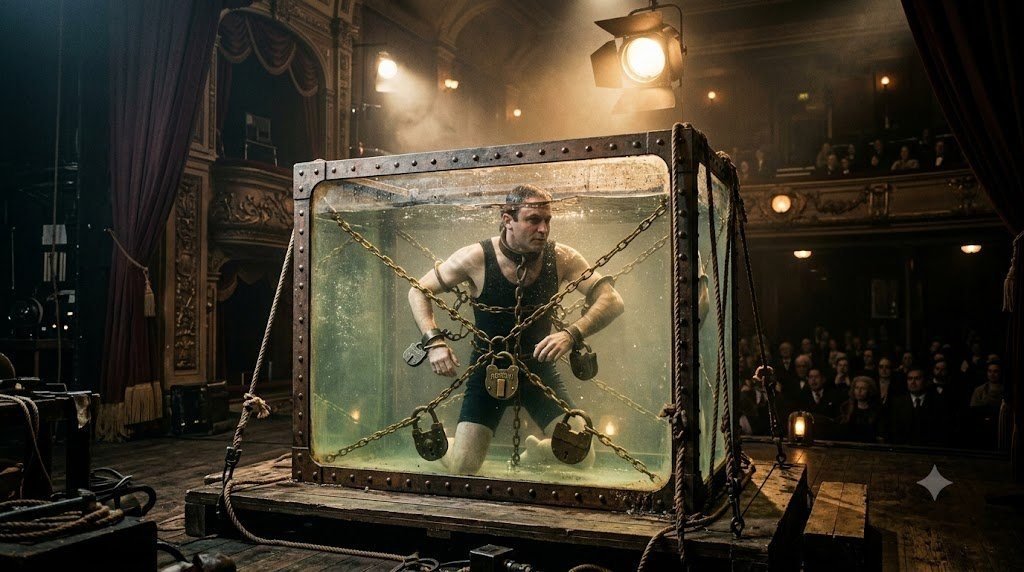
Houdini did not invent escapology, but he elevated it from a secondary theatrical novelty into a cultural phenomenon of mythic proportions. Prior to Houdini, magicians escaped from wooden cabinets or loose ropes behind closed curtains. Houdini stripped down to his underwear, invited local police chiefs to search his body with medical scrutiny, permitted blacksmiths to rivet him in custom iron shackles, and challenged the public to devise inescapable contraptions: milk cans filled with water, packing crates nailed shut and dropped into freezing rivers, straitjackets, and maximum-security penitentiary cells. In doing so, Houdini forged a new theatrical archetype: the sensational escape artist whose performances pulsed with genuine physical peril, physiological endurance, and transcendent catharsis.
In an era characterized by labor strikes, rigid social stratification, and anxieties over mass incarceration, Houdini’s public performances carried immense socio-political resonance. For the working-class immigrant struggling against economic oppression, witnessing a fellow immigrant bound in the heaviest chains of the state and bursting triumphantly free within minutes was an exhilarating symbol of liberation and human dignity. Houdini was not merely an entertainer; he was the living embodiment of the unconquerable spirit.
⛓️ Houdini’s Core Axiom of Escapology
‘My chief task has been to conquer fear. When I am stripped and nailed into a submerged packing case, the slightest panic would mean death. The public does not come to see me perform a trick; they come to see a man conquer the impossible or die trying.’
The Handcuff King: Anatomy of Lockpicking, Anatomy, and Concealment
Houdini’s initial international breakthrough occurred under the billing ‘The Handcuff King’. Arriving in London in 1900 with his manager Martin Beck, Houdini marched directly into Scotland Yard, allowed Superintendent Melville to lock his arms around an immovable stone pillar with British regulation cuffs, and slipped free within moments, instantly securing a lucrative residency at the Alhambra Theatre. Everywhere he traveled—across Germany, France, Russia, and the United States—Houdini repeated this sensational publicity stunt: visiting city police headquarters, stripping naked to undergo invasive cavity searches, and escaping from the jail cells that held the region’s most dangerous murderers.
How did Houdini accomplish these seemingly superhuman jailbreaks? His methodology was a masterful synthesis of applied locksmithing, extraordinary anatomical conditioning, and psychological misdirection:
- Lock Mechanism Expertise: Houdini possessed an encyclopedic knowledge of lock mechanics. Most nineteenth-century handcuffs (such as Bean Giants, Adams, or Darbys) utilized simple spring-loaded ratchet bolts. Houdini knew that a sharp, calibrated mechanical strike against a hard surface—or the application of a powerful hidden solenoid/magnet—could cause the internal pawl of a ratchet cuff to bounce open momentarily due to inertia.
- Skeletal Dislocation and Contortion: Houdini had trained his body from childhood in gymnastics and contortion. He possessed the rare physical ability to voluntarily dislocate both of his shoulders, dramatically compressing his skeletal circumference to slip out of tight restraints, and could expand his thoracic cavity while being bound with ropes, leaving ample slack when he exhaled.
- Miniature Tool Concealment: Houdini was a master of physical concealment. He designed micro-picks, clockwork spring shims, and split-key tools concealed within false skin-colored wax patches, hollowed-out boot heels, small lead tubes swallowed and regurgitated through regurgitative esophageal control, or wedged between his toes.
- The Mirror Challenge: In March 1904, at the London Hippodrome, the Daily Mirror newspaper challenged Houdini with a bespoke pair of cuffs designed by master locksmith Nathaniel Hart, featuring six concentric brass tumblers that took five years to manufacture. In an agonizing battle lasting over an hour inside his ghost house cabinet, Houdini emerged exhausted, sweating, his coat cut off, but holding the unlocked Mirror cuffs aloft, solidifying his immortality.
| Legendary Escape | Debut Year & Venue | Restraint Apparatus | Primary Mortal Hazard | Mechanical / Physiological Secret |
|---|---|---|---|---|
| The Handcuff Challenges | 1900 (Alhambra, London) | Darbys, Bean Giants, Mirror Cuffs | Permanent joint dislocation, arrest | Skeletal dislocation, inertial tapping, concealed shim picks |
| The Milk Can Escape | 1908 (St. Louis, MO) | Galvanized steel can filled with water, padlocked | Asphyxiation / drowning in under 3 minutes | Riveted neck collar rotated on secret bayonet flange |
| The Water Torture Cell | 1912 (Circus Busch, Berlin) | Vertical glass/mahogany tank, suspended upside down | Sudden drowning, hypothermia, trapped ankles | Secret corner release of ankle stocks, breath holding for 3+ minutes |
| Suspended Straitjacket | 1915 (Kansas City / NYC) | Heavy canvas lunatic restraint hung 100ft high | Fatal plummet to pavement, shoulder dislocation | Expanding chest during buckling, biting through arm buckle |
| Bridge Jumps & Packing Crates | 1912 (East River, NYC) | Crate weighted with 200 lbs lead, nailed shut | Impact shock, freezing river current, trapped latch | Concealed swinging panel in rear of crate secured by spring catch |
| The Buried Alive | 1926 (Galvanized Casket) | Sealed casket submerged in hotel swimming pool | CO2 poisoning, hypercapnia, panic | Physiological metabolic slowing, controlled shallow diaphragmatic breathing |
| Russian Siberian Transport Van | 1903 (Moscow, Russia) | Zinc-lined, padlocked Siberian prisoner transport rail car | Exile, asphyxiation, locked steel padlock | Miniature saw blade and lock-pick concealed in hollowed heel |
The Suspended Straitjacket from Soaring City Skyscrapers
Perhaps no outdoor stunt in Houdini’s repertoire captured the sheer vertigo and terror of the public imagination quite like the Suspended Straitjacket Escape. Standard straitjackets used in psychiatric institutions at the turn of the century were designed from heavy sailcloth canvas, reinforced with thick harness leather, featuring sleeves extending past the fingertips that wrapped around the torso and buckled behind the patient’s back. Escaping while standing on the floor was impressive; escaping while dangling upside down over a city street was sheer theatrical insanity.
Houdini would arrange with local newspaper publishers to have a crane, block-and-tackle, or construction hoist erected atop the roof of a towering skyscraper, typically eighty to one hundred feet above the street pavement. Massive crowds numbering between twenty thousand and fifty thousand people would pack the avenues below, staring upward with bated breath. Houdini was securely laced and buckled into the canvas restraint by burly asylum attendants or police officers. His ankles were secured in heavy leather anklets connected to a steel cable, and he was hoisted upside down into the sky, swaying precariously in the buffeting city winds.
To escape, Houdini first expanded his chest and arched his back during the buckling process, creating hidden inches of slack. Once suspended inverted, gravity worked in his favor, pulling the canvas down toward his shoulders. Dislocating his left shoulder, he wriggled his dominant arm over his head, brought the restraint’s elbow buckles to his mouth, and used his teeth to bite through and unfasten the main buckles. Within ninety seconds of furious muscular writhing in mid-air, the canvas straitjacket dropped away into space, and Houdini swung free, waving to the roaring, ecstatic crowds below.
The Chinese Water Torture Cell: The Apex of Theatrical Tension
In 1912, seeking an escape that would be completely immune to copycats, Houdini unveiled what is universally recognized as his artistic masterpiece: ‘The Chinese Water Torture Cell’ (patented under the title ‘Houdini’s Upside Down!’). The apparatus was an imposing mahogany-and-nickel-plated steel cabinet featuring a front panel of three-quarter-inch laminated plate glass, illuminated from within so the audience could see the water sloshing inside.
The staging of the Water Torture Cell was a triumph of psychological theater. Houdini’s feet were locked into two heavy mahogany stocks. Cables connected to a block-and-tackle hoist hoisted him upside down into the air. He was then slowly lowered headfirst into the narrow tank, which was overflowing with cold water. The mahogany stocks were locked down tightly into the top rim of the cabinet with massive brass padlocks. A silk cabinet was drawn around the tank, and an assistant stood nearby with a heavy fire ax, dramatically instructed to smash the glass if Houdini did not emerge within two minutes.
The reality of the apparatus was terrifyingly dangerous, yet ingeniously engineered. While Houdini legitimately possessed the extraordinary lung capacity to hold his breath for over three minutes in freezing water, the escape relied on a brilliant mechanical release built into the mahogany stocks. By flexing his abdominal muscles and executing an explosive inverted crunch, Houdini engaged a concealed internal latch inside the wooden collar that allowed the ankle grips to slide outward, releasing his legs. Once his lower body was freed, he maneuvered himself upright within the narrow tank, unlocked the top lid from the inside, and stepped out behind the curtain, soaking wet and gasping for air, driving audiences into pandemonium.
The Bridge Jumps: Freezing Rivers and Public Spectacle
Long before modern mass marketing and viral media campaigns existed, Houdini understood the power of outdoor civic spectacle. Whenever ticket sales for an upcoming theater engagement needed a boost, Houdini contacted city newspapers and announced a death-defying bridge jump. Clad in heavy iron shackles and handcuffs, Houdini leaped from towering suspension bridges—such as the Belle Isle Bridge in Detroit, the Harvard Bridge in Boston, or the Brooklyn Bridge over the East River—plunging forty to seventy feet into icy waters below.
Crowds numbering in the tens of thousands lined the riverbanks and bridges, paralyzing city traffic. Underwater, out of view of the freezing crowds, Houdini worked with lightning speed: using shims or keys palmed in his hands, he slipped the cuffs, surfaced triumphantly holding the iron chains above his head, and swam to a waiting tugboat. These public spectacles cost nothing to view, yet transformed him into a working-class folk hero across the globe.
The Crusade Against Spiritualism: Defending Truth in an Age of Grief
Following the horrific carnage of World War I and the 1918 Spanish Flu pandemic, millions of grieving families sought solace in the Spiritualist movement, desperately paying mediumistic psychics to communicate with fallen sons, husbands, and fathers. In 1920, following the death of his beloved mother Cecilia Steiner Weisz, Houdini himself investigated Spiritualism, hoping against hope to receive a genuine sign. What he found instead was an industry of heartless, predatory fraud.
Armed with thirty years of elite conjuring expertise, Houdini embarked on a crusade that consumed the final years of his life. He recognized that scientists, university professors, and literary titans—most notably his friend Sir Arthur Conan Doyle, the creator of Sherlock Holmes—were hopelessly naive observers. Scientists were trained to observe natural phenomena that did not deliberately cheat; magicians, conversely, were experts in human deception.
The friendship between Houdini and Arthur Conan Doyle fractured irreparably during a seance in Atlantic City in 1922. Lady Doyle, claiming to be in a deep trance, produced fifteen pages of ‘automatic writing’ allegedly dictated by Houdini’s late mother. The pages began with a Christian cross and were written in fluent, grammatical English. Houdini was heartbroken and furious: his mother was the wife of a Jewish rabbi and spoke almost no English, speaking strictly Hungarian and Yiddish throughout her life. Houdini realized that Conan Doyle was blinded by grief and wishful thinking.
In 1924, as a member of the Scientific American committee offering a $5,000 prize to any medium who could produce genuine psychic phenomena, Houdini famously exposed the celebrated Boston medium Mina ‘Margery’ Crandon, constructing a specialized wooden inspection box that immobilized her limbs and proved her ‘teleplasmic spirit hands’ were nothing more than carefully carved animal intestines and foot-manipulated props.
The Ten-Year Seance Pact with Bess Houdini
Before his untimely death, Houdini and his devoted wife, Wilhelmina Beatrice ‘Bess’ Rahner, established a secret scientific pact. Determined to test whether human consciousness could survive physical death and communicate with the living, Houdini agreed upon a secret ten-word coded message known only to the two of them: ‘Rosabelle, answer, tell, pray, answer, look, tell, answer, answer, tell’ (which decoded via a secret mentalist alphabet to spell the word ‘BELIEVE’, referencing the lyrics of the love song ‘Rosabelle’ that Bess had sung when they first met).
For ten consecutive years following Houdini’s death, on every Halloween night from 1927 to 1936, Bess Houdini hosted an official public seance. Prominent mediums from across the globe gathered to channel the great escapologist. When medium Arthur Ford claimed in 1929 to have cracked the code, an intense public scandal erupted; Bess initially signed a statement supporting Ford, but later recanted, confirming that the message had been deduced through published biographical clues rather than supernatural transmission.
On Halloween 1936, atop the roof of the Knickerbocker Hotel in Hollywood, Bess conducted the Tenth and Final Houdini Seance, broadcast live via radio to millions of listeners. As the clock struck midnight and the storm clouds passed without a whisper, Bess turned off the ceremonial electric lamp burning next to Houdini’s portrait. She stated with dignified finality: ‘Houdini did not come through. My last hope is gone. I do not believe that Houdini can come back to me, or to anyone. The ten years are up. It is finished. Good night, Harry.’ With that poignant pronouncement, the greatest escapologist in history remained securely locked within the eternal mystery of death.
The McGill University Dressing Room Incident and the Death of a Legend
On October 22, 1926, while resting in his dressing room at the Princess Theatre in Montreal, Houdini was visited by McGill University students, including J. Gordon Whitehead. Whitehead asked Houdini if it was true that he could withstand any blow to the stomach without injury. Before Houdini—who was lying down nursing an ankle injury—could tense his abdominal muscles to prepare for the impact, Whitehead struck him with several sudden, ferocious hammer blows directly into the abdomen.
Though in excruciating agony, Houdini refused to cancel his tour, boarding a train for Detroit, Michigan. During his performance at the Garrick Theatre on October 24, his fever reached 104 degrees Fahrenheit, and he collapsed shortly after the final curtain. Rushed to Grace Hospital, surgeons discovered that his appendix had ruptured, leading to severe streptococcal peritonitis. In an era before the discovery of penicillin, the infection was fatal. On Halloween afternoon, October 31, 1926, Harry Houdini passed away at the age of fifty-two, uttering his famous final words: ‘I’m tired of fighting… I guess this thing is going to get me.’
Conclusion: The Enduring Archetype of Human Liberation
Harry Houdini remains the most famous magician who ever lived because his art touched something profound in the human soul. While other magicians demonstrated clever parlor puzzles, Houdini dramatized the universal struggle against mortality, confinement, and darkness. He proved that no lock is permanent, no cage is absolute, and no spirit can be shackled by tyranny. Nearly a century after his death, the name ‘Houdini’ remains the ultimate global synonym for liberation, resilience, and the triumph of the human will.